May 27, 1980: The Day the Tigers Traded Jason Thompson

Twenty-eight years ago today, Tigers GM Jim Campbell broke my heart.

On May 27, 1980, he traded my favorite Tigers player, first baseman Jason Thompson, to the California Angels for outfielder Al Cowens. (For more on Cowens, check out this post.)
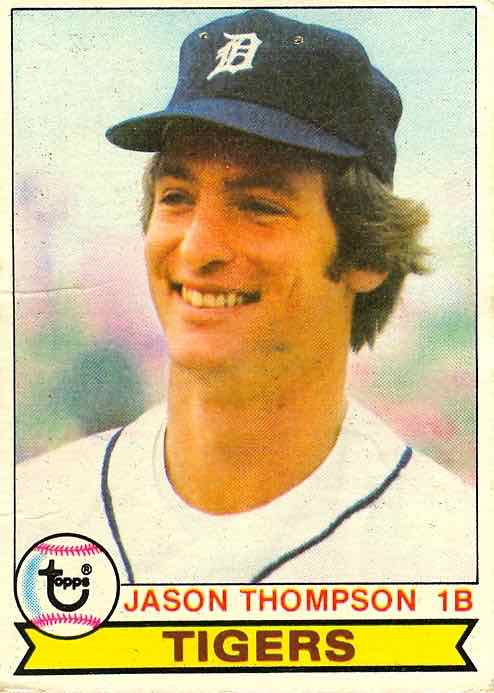
The Hollywood native joined the Tigers full time in 1976 and played 123 games that year, hitting .218, with 17 home runs and 54 RBI. Two of the homers cleared the rightfield roof at Tiger Stadium. It was in 1977, though, that he made his mark: .270, 31 homers and 105 RBI — and earned an All Star Game selection.

The 1977 Tigers yearbook noted:

Jason led the Tigers with 31 home runs and 105 RBI — the first Tiger since Norm Cash (32) in 1971 to top 30 homers and the first since Willie Horton (100) in 1966 to attain the century mark in RBI.

At that point, the Tigers had to like their team of the future: Thompson, Lou Whitaker, Alan Trammell, Lance Parrish, Steve Kemp, Ron LeFlore, Jack Morris, et al, with a third baseman to be named later.

Thompson had another solid year in ’78, hitting .287 with 26 homers and 96 RBI.

The Beginning of the End in Detroit … Already?!

In 1979 he continued to hit homers and drive in runs — 20 and 79, respectively — but his average dropped 40 points to .246. That was also the year that Sparky Anderson arrived and, so the story goes, Thompson and Sparky didn’t mesh.

In 1980, Thompson got off to a slow start: .214/4/20 in 36 games, and Sparky invoked his My Way or the Highway clause and sent his first baseman to Orange County.

As I’ve said before, Thompson’s replacement, Richie Hebner, was a favorite of mine too. But, who were the Tigers kidding? Hebner over Jason Thompson?
From Anaheim to Pittsburgh to Montreal

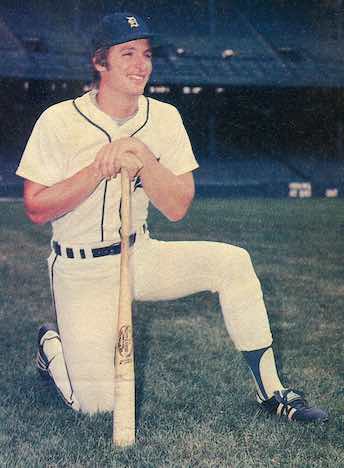
Back home in southern California, Thompson thrived. In 102 games he batted .317 with 17 homers and 70 RBI. (Hebner hit .290/12/82.) On the eve of the 1981 season the Angels traded the three-time All Star to the Pirates for Ed Ott and Mickey Mahler.

In his five seasons in Pittsburgh, Thompson hit 93 home runs and averaged 93 RBI (not counting the 42 in the shortened ’81 season).

On April 4, 1986, the Pirates traded him to the Montreal Expos for players to be named later. Thompson played only 30 games for the Expos, hitting .196 with no home runs and just four RBI. On June 30, at the age of 31 and with balky knees, Jason Thompson was out of baseball for good.

The Jason Thompson Curse

If you remove the years that Darrell Evans and Cecil Fielder manned first base, the Tigers have had a revolving door at the position since they traded Jason Thompson. I call it The Curse of Jason Thompson: Hebner, Enos Cabell, Dave Engle, Keith Moreland, Tony Clark, Eric Munson, Carlos Pena, Chris Shelton, Sean Casey and Carlos Guillen. (And now, of course, Miguel Cabrera. Though I’m not convinced he’s long for first base.)

When looking back on the 1984 World Series team, I often think about how that team, or three-quarters of the starting nine, could’ve been homegrown talent — if Thompson were still in Detroit then.

With the exception of Chet Lemon and Larry Herndon, the Tigers could’ve had six of eight starters developed from Lakeland on up. (Or seven of nine if Morris or Dan Petry were on the hill.) Quite a different scenario from the 2008 Tigers when only two full-time, homegrown position players — Curtis Granderson and Matt Joyce — roam the field.

Today Thompson runs “Jason Thompson Baseball” in Auburn Hills, where kids can get hitting and fielding instruction from old #30 himself. He’s also an executive with Wachovia Securities.

If you can’t tell, even 28 years later I’ve still not gotten over the trade involving my favorite childhood player. I quickly hitched my wagon onto Hebner as a way to ease the pain. But that didn’t last long either, come to think of it.

So I threw my allegiance behind Kirk Gibson and five years later, when Gibson signed with the Dodgers, had to deal with the anguish all over again.

Happy Birthday, Darrell Evans


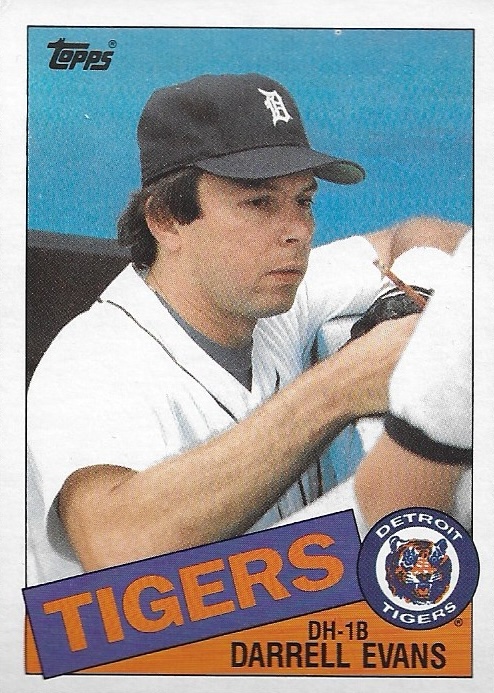
Happy 61st (?!) Birthday to ol’ #41 Darrell Evans.

Before Pudge Rodriguez and Magglio Ordonez, the Tigers’ big splash in the free agent market came on Dec. 17, 1983, when they signed the 36-year-old slugger.

As most seasoned Tigers fans remember, the free agency was anathema to the club’s leadership. Former Tigers GM Jim Campbell hated paying for his own free agent players — and loved to trade them before their walk year. He certainly wasn’t going to dole out cash for someone else’s players.

I can distinctly remember the old “re-entry draft” which created a competitive auction market for the services of veteran players. The Detroit News and Free Press would list, usually in agate type, each team and the free agents it “drafted.” Year after fifth-place year I would read “Detroit: No selections made.”

That changed in 1983 when Evans chose a Detroit offer which was, of course, lower than those of the Yankees, Giants and other clubs that tried to sign, or in the case of San Francisco, re-sign him. The allure of joining a team poised to win now (or then, as it were) made Detroit the best choice.

In his first game as a Tiger, April 3, 1984, Evans homered of the Twins’ Keith Comstock — a three-run jack — and Detroit was off to the races. A week later, on Opening Day in Detroit, he homered in his first Tiger Stadium at bat, an upper-deck blast of the Rangers Dave Stewart. He’d hit only 14 more home runs that year, but quickly became a fan favorite.

In five seasons with the Tigers, Evans hit 141 of his career 414 home runs. In 1989, he finished his career where it began: with the Atlanta Braves.

Today’s Tigers fans may be used to their team being in the mix for big-name free agents. But it certainly wasn’t the case in the late 1970s and early ’80s. And what better guy to break that bad habit than with Darrell Evans?

Today’s Tiger: Stan Papi

Papi Stan
…When, on May 14, we failed to acknowledge the 57th birthday of former Tigers infielder Stan Papi.

The Tigers purchased Papi’s contract from the Phillies on May 29, 1980 and he made an immediate splash in Detroit.

On Friday, May 30 against the Angels, Papi started at second base and batted ninth (behind the number-eight hitter, Kirk Gibson).

He struck out against Frank Tanana in the bottom of the second but in the fourth smacked a two-run home run of Tanana to give the Tigers and Milt Wilcox a 4-1 lead. He singled in his next at bat and then tripled in the sixth off Jim Barr. The Tigers won the game 12-1.

Papi finished the 1980 campaign with a .237 average, three homers and 17 RBI in 46 games. He hung around for 40 games in the strike-shortened 1981 season, hitting just .204.

His last appearance in a big-league game came on Oct. 1, against the Orioles at Tiger Stadium. Sparky inserted him as a pinch hitter for Rick Leach in the seventh; Papi struck out against Tippy Martinez to end the inning.

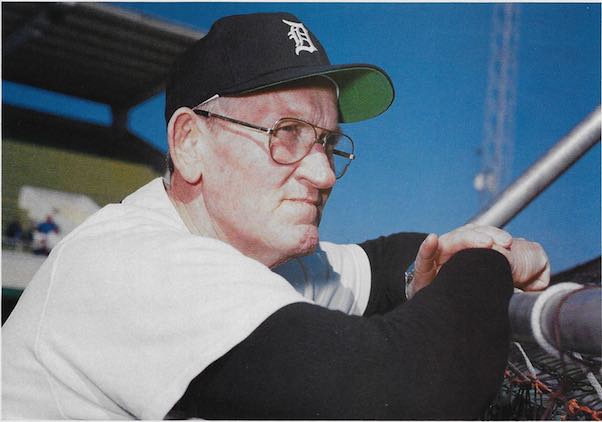
Remembering the Les Moss Era

When you search for “raw deal” on Google, the first entry is for the 1986 film by the same name starring Arnold Schwarzenegger, Kathryn Harrold and Darren McGavin.

Twenty-nine years ago Les Moss got a raw deal in his second big-league managing job.

Yes, second. He managed the 1968 White Sox for just 36 games, going 12-24.

In 1979, John Lester Moss took over for the retired Ralph Houk as Tigers manager. Moss had been in the Tigers farm system managing the Triple-A Evansville (Ind.) Triplets in the American Association and it was, I guess, his turn.

Moss managed the Tigers for just 53 games in ’79. Detroit sat at a 27-26, on the morning of June 14. Before Moss could order lunch, he was out of a job and Sparky Anderson was the Tigers’ new manager. (Officially, first base coach Dick Tracewski was the interim manager. Trixie led the Tigers to a 2-0 record before Sparky took over.)

So the Moss Era was over before it even began. The managing era, that is.

Did you know that Les Moss had a 13-year career as a catcher in the majors? He debuted in 1946 as a 21-year-old with the St. Louis Browns. He played in just a dozen games that year but finished a .371 average.

A review of his year-by-year stats show one thing: he was ridiculously inconsistent. For example:

  • 1947: 96 games, .157 avg.
  • 1948: 107/.257
  • 1949: 97/.291
  • 1950: 84/.266
  • 1951: 87/.193

…and so on. What else?

  • He never hit more than 14 homers in a season
  • His career average was .247; career OBP: .333

Though he didn’t hang around Detroit for very long, Les Moss is another player in the Tigers’ rich history.

Today the Tulsa native turns 83.

**Update: Moss passed away Aug. 29, 2012.

Happy Birthday, Sweetness

Whitaker.jpg
How in the world did Lou Whitaker turn 50 — forget about 51, which he is today? Lest we’ve forgotten, let’s take a quick stroll down memory lane on his 19-year career with the Tigers:

  • 2,390 games
  • .276 average
  • 2,369 hits
  • 244 home runs

If you’re keeping score at home, Whitaker averaged a hit a game over his career. (Actually he averaged .991 hits a game, but when it’s your birthday, you benefit from rounding up.)

And how is he not in the Hall of Fame? Jeez!

Notable Hardware

  • 1978 Rookie of the Year
  • Five-time All Star
  • Four-time Silver Slugger
  • World Series Champion

Here’s hoping that Sweet Lou enjoyed his birthday at home in Lakeland, Fla., or a local theme park.