Shortly before Thanksgiving I was re-reading* Peter Walsh’s book “It’s All Too Much“, a treatise on de-cluttering home, office and life. (*Actually, I was re-listening to it as an audiobook.) Walsh, who is a regular on Oprah, TLC and other TV shows, made one particular point in this reading that hit home: If something is valuable and cherished, why is it in a box in your garage?
After hearing this I immediately glanced over at my crudely boxed baseball card collection and thought, “Yep. They deserve better.” And what better time to do this than over the holidays and near the start of a new year?
I first began collecting baseball cards regularly starting in 1977, though I do have random cards from earlier years, like this Mickey Stanley from Topps’ 1976 1977 series. (I’m not sure where many of the earlier ones came from; probably from my brother or from garage sales.) I stopped collecting — and by collecting I mean buying one or two packs of cards every week — in 1981. From then on, I’d buy one pack of cards a year just to see what the new season looked like.
This project would be like time travel for me, putting me face-to-face with cards that are tattooed to my memory — The Mets’ Bruce Boisclair posing with an aluminum bat; Doug Rau‘s chipmunk-cheek full of chaw — and some I’d hadn’t thought about in years.
Phase 1: Strategy
Before I could dive in completely, I had to decide how I use them. And that was one of the drivers behind this project. Over the past year or so, I’d been going to my collection to find cards of current or former Tigers players so that I could use it in a post on The Daily Fungo. I soon discovered that unruly stacks of cards were neither efficient nor convenient for my process.
Various and SundryMy card collection featured many bizarre pieces. From the Rennie Stennett card from the bottom of a Hostess Twinkie box to the 1980 Donruss card with Royals’ reliever Paul Splittorff‘s name misspelled as Spittorff.
 Originally (and admittedly late at night when brain horsepower was but a flicker) I planned to organize the cards alphabetically across-the-board. My thinking was, if I needed to find Champ Summers, why have to figure out what team he was on first and then find his card? With the benefit of a night’s sleep, I realized that would not only suck the life force from me, but it would reach unprecedented levels of tedium. Thus was born Plan B:
- Organize by year
- Then by team
- Then alphabetically by player’s last name
- Place each card in a plastic sheet (nine cards per sheet)
- File in three-ring binders by year
- Enjoy
But first, I needed to do some serious due diligence.
Phase 2: Triage and Vivid Memories
I wish I’d kept track of the many times I’ve sifted through my collection. One thing’s for sure, the condition of the cards themselves was evidence that it was A) at least once a year, and B) the frequency and care I took with them rendered them worthless on eBay. But that was the entire point of my baseball cards: I bought each pack to read them, learn from them and enjoy them. I never pretended that they would be a source of revenue.
This was the fun part, looking at the cards and remembering the precise trip to the corner store that secured them. (At least I think I remember specific purchases; who knows?) And the process was repeated for almost every purchase:
- Ask Dad for 25¢.
- Ride bike to Johnny’s Party Market and hope that Johnny himself was not there (to glare eerily at me in his drab olive green short-sleeve sweatshirt) but rather his very nice wife; Avoid eye contact if Johnny was behind the counter.
- Buy one 20¢ pack of Topps and one 5¢ Red Hot Fireball.
- Pray that at least one Tigers player was in the pack.
Where was I?
This exercise of culling the dupes also reinforced that fact that I’d recently turned 40. (Wow! Vic Davillilo is now 72?! Or, Rico Carty is still with us?) And, it shows how far we’ve come from the days when Topps would try to actually paint a player’s new team hat on him. (Don’t believe me? See Paxton, Mike, Topps 1978.) I had my own system for indicating that a player had been traded. On the Juan Beniquez 1976 card, for example, I wrote “Traded to Rangers.”)
Ah, youth.
 When all was said and done, I’d nearly filled a shoebox with doubles and triples.
Phase 3: A to Z
Yeah. Good idea to ditch the full-blown alphabetizing idea. Thankfully, my wife was kind enough to help me tackle this administrative process. Over the course of four nights we organized and alphabetized:
- About 100 random cards from 1972-2007
- Hundreds of 1977-79 Topps
- The complete set (my only complete set) of 1980 Topps
- Hundreds of 1990 Topps
- Hundreds of 1990 Bowman cards
The result? Every surface in my office covered with stacks of cards waiting for Phase 4.
Phase 4: Sheeting!
This, again, would’ve been a longer process had my wife (and, to a lesser degree, my mother-in-law) not pitched in. I placed several teams worth of cards in the sheets instead of watching the Lions/Titans game on Thanksgiving. Speaking of sheets, I opted to have one card per slot so that I could see front and back. This, of course, meant buying a truckload of sheets from Target and Amazon. In the end, I filled 360 sheets with more than 3,200 cards.
Phase 5: Storing
Today my baseball cards are in neatly arranged and filed away in a series of binders, labeled by year and brand — with two exceptions. One binder is dedicated to all my Detroit Tigers cards regardless of year or brand. Another small binder is for years and brands of cards that are so random they can only be lumped by year and alphabetized.
As you can see in the photo, what was once thousands of cards squeezed into boxes of varying shapes and sizes, is now a tidy, organized and easily referenced collection. (This is three of the seven binders.)
It’s been close to 30 years since I actively collected baseball cards and chances are I won’t start again. I did think about buying a complete set each year for my son until he was in high school, but that notion was lost along the way. Plus, I didn’t want to saddle him with 18 years worth of baseball cards if he didn’t want them.
But, at the very least, if he should want to browse through his Dad’s collection, they are in a state that won’t scare him away. At last.

 Whenever I watched
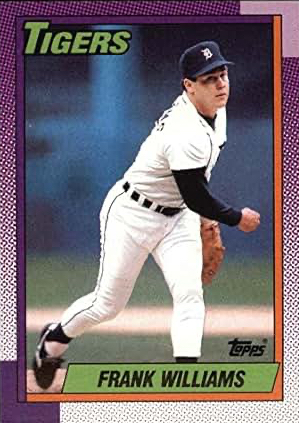
 Happy New Year to you and Happy 56th Birthday to former Tigers outfielder
  dailyfungo.com