According to Baseball Reference, 54 players have worn the number 12 in Tigers franchise history. Casey Mize currently wears it. Let’s look at a few Tigers that wore number 12 during the Fungo’s focus, 1977 through 1994:
After losing two of three to the Blue Jays, the Tigers travel to visit another A.L. East rival, the Brewers, for a three-game weekend set at County Stadium.
Record: 44-16 — 6 games up on Toronto
So here’s another June 14 game. This one from 1978:
Record: 31-27 — Fifth place, 91/2 games back of Boston
Highlights
The Tigers scratched out just four hits off of Splittorf who threw a complete-game gem.
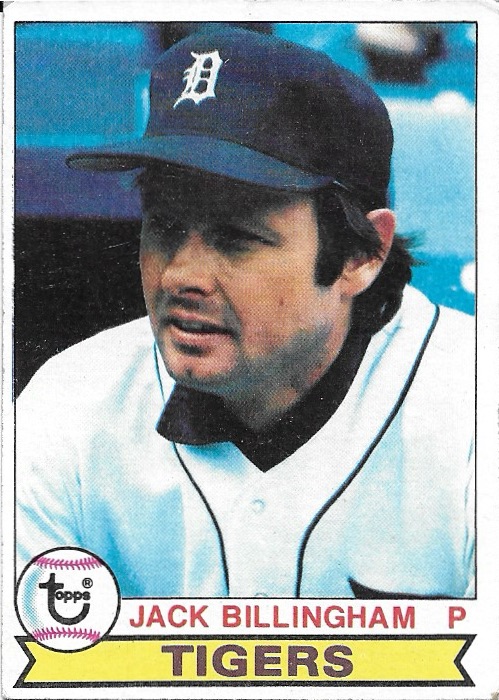
Billingham was roughed up for eight hits and four walks in six innings, and allowed five earned runs.
Mickey Stanley‘s fifth-inning homer was the Tigers highlight.
Miscellany
Venue: Royals Stadium
Umpires: HP – Dave Phillips, 1B – Larry McCoy, 2B – Steve Palermo, 3B – Don Denkinger
Time of Game: 2:05
Attendance: 21,025
Mike Laga – 1B #4
The first paragraph of the 1984 Tigers Yearbook profile on Mike Laga pretty much summed it up:
“Mike Laga has been called the Tiger first baseman of the future. And despite the presence of a veteran star like Darrell Evans, it seems clear the Tigers still have high hopes for Laga.”
I’d go so far as to say we still have high hopes for Laga.
We heard so much about the left-handed hitting slugger but he didn’t capitalize on his brief visits to Detroit from 1982 through 1986 — and as I recall, injuries were a problem.
1982: Laga made his debut on Sept. 1, 1982 against the Angels and faced Ken Forsch, flying out to left. Two days later he hit his first homer, a two-run shot, off the A’s Rick Langford. He played in 27 games for ’82 Tigers, essentially the starting first baseman in September.
1983: The bulk of his season was spent in Evansville with a dozen games in Detroit: 21 at bats, no homers, .190 average.
1984: Laga again was a September call up but appeared just nine games: but he hit .545 — six for 11.
1985: Another nine-game stint. Thirty six at bats, two home runs, .167 average.
1986: Laga made the Opening Day roster and appeared in 33 games before being sent to Nashville. The Tigers traded him to the Cardinals, as a player to be named later, along with Ken Hill for catcher Mike Heath.
His final numbers with Detroit: 72 games, .239 avg., eight home runs, 28 RBI and a .691 OPS.
The Tigers were down 7-0 heading to the eighth. Wilcox, five innings, four runs, and Doug Bair, two innings, three runs, took the brunt of the damage.
Stieb shut down Detroit over seven innings, allowing just three hits.
Classic Darrell Evans: one for one with three walks.
Miscellany
Venue: Exhibition Stadium
Umpires: HP – John Hirschbeck, 1B – Steve Palermo, 2B – Dave Phillips, 3B – Jerry Neudecker
Time of Game: 2:28
Attendance: 34,122
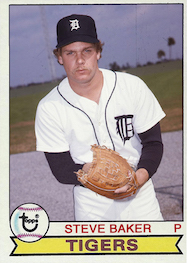
Steve Baker – RHP #31
Steve Baker‘s major-league debut was a good one. On May 25, 1978, he started against the Orioles and went 61/3 and allowed just one run on eight hits and six strikeouts. Baltimore scored off of John Hiller in the eighth to take a 2-1 lead, and that was the final score.
According to his profile in the 1979 Tigers Yearbook, managers in the American Association, to which Triple-A Evansville belonged, in 1978 picked Baker as “the best prospect and pitcher with the best curve.”
He pitched in 15 games for the ’78 Tigers, 10 of them starts, finishing with a 2-4 record and a 4.55 ERA.
In 1979, Baker’s career with the Tigers nosedived in a hurry.
May wasn’t kind to Baker, June and July were worse — and, well, August just piled on.
June: Three starts, 121/3 innings, 13 earned runs.
July: Four starts, 271/3 innings, 16 earned runs
August: One appearance, 4 innings, six hits, four earned runs
When the dust settled, Baker had just one scoreless appearance all year, and finished 1-7 with a 6.64 ERA and one save.
He began the 1980 season in Evansville before the Blue Jays purchased his contract on June 6. Baker’s final Tigers line: 3-11, 5.74 ERA and that one save.
Kirk Gibson hit a first-inning homer to put the Tigers up 1-0 … and then the Mariners took control, scoring four off Berenguer in the home half.
Berenguer retired only one batter: Seattle’s leadoff hitter, Jack Perconte. The following hitters walked, singled, singled, singled, then a wild pitch, and two more singles. Mariners 4, Tigers 1.
Umpires: HP – Mike Reilly, 1B – Al Clark, 2B – Don Denkinger, 3B – Rich Garcia
Time of Game: 2:51
Attendance: 41,342
Bob Sykes #27
The Tigers drafted lefty Bob Sykes in the 19th round of the 1974 MLB June Amateur Draft from Miami Dade College.
After three seasons in the minors, he made his debut on April 9, 1977, at age 22, pitching four-and-two-thirds in a Royals 16-2 rout — but he managed to blank K.C., allowing just two hits and a walk.
Sykes appeared in 32 games that season, 20 of them starts, and finished with a record of 5-7 and a 4.41 ERA.
In 1978, appeared in 22 games, starting 10 and throwing a pair of shutouts. His record was 6-6 with a 3.94 ERA; he also earned two saves.
That offseason, Dec. 4, 1978, he was traded to the Cardinals, with minor leaguer John Murphy, in a deal that worked out well for the Tigers, who received Aurelio López and Jerry Morales in return.
Sykes’ final numbers in Detroit: 11-13, 4.22 ERA and two saves. He pitched three seasons in St. Louis before being traded to the Yankees for a young outfielder named Willie McGee.
Foucault allowed six hits in two-and-a-third innings, including four in the 11th, and gave up the winning run.
Both teams had 12 hits.
Miscellany
Venue: Kingdome
Umpires: HP – Rich Garcia, 1B – Vic Voltaggio, 2B – Nestor Chylak, 3B – Ron Luciano
Time of Game: 3:20
Attendance: 7,474
Steve Kemp #33
When the Tigers traded left fielder Steve Kemp to the White Sox for Chet Lemon, it was the quintessential Jim Campbell Winter Meetings Trade™.
Kemp made too much money and former GM Campbell didn’t like players who held out (Rusty Staub) or won in arbitration (Kemp, again).
Campbell also liked to trade players who, like Kemp and Ron LeFlore in 1979, were entering their walk year.
Steve Kemp was terrific during his five years patrolling left field at Tiger Stadium. He produced a .284 average, 89 home runs (lowered a bit with his nine homers in the strike-shortened 1981 season), and averaged 84 RBI and 23 doubles. He also displayed a keen eye at the plate averaging 75 walks — including 97 in 1978.
On Nov. 27, 1981, the Tigers and White Sox swapped outfielders — both who were former top selections in the amateur draft — Lemon by Oakland in 1972, Kemp number-one overall by Detroit in 1976. They were roughly the same age and had put together similar careers to that point.
In his only season in Chicago, Kemp had a career year batting .286 with 19 HR and 98 RBI in 160 games. After the ’82 season Kemp cashed in on a free-agent contract with the Yankees.
In 1983, Kemp hit .241 with just 12 home runs in 109 games. After the ’84 season he was traded with Tim Foli and cash to the Pittsburgh Pirates for Dale Berra, Alfonso Pulido and Jay Buhner.
An eye injury, suffered when Kemp was hit by a batted ball in batting practice, shortened his career in the mid-1980s. He last played in the majors in 1988 when he played in 16 games for the Texas Rangers, hitting just .222 in 36 at bats. His career batting average in 11 seasons was .278 — five points higher than Lemon’s.
When Campbell pulled the trigger on the Kemp-for-Lemon deal he probably had no idea that Kemp would flame out and that Chet the Jet would play more than 1,100 games in the outfield for Detroit.
Still, he had to like the odds that the trade would work out better than LeFlore for Dan Schatzeder.




 dailyfungo.com