Both teams scored in the 10th — which Sutcliffe started and quickly departed after allowing a leadoff double to Lou Whitaker, who went 3 for 7 on the night. (Poor Cleveland DH Andre Thornton went 0 for 9.)
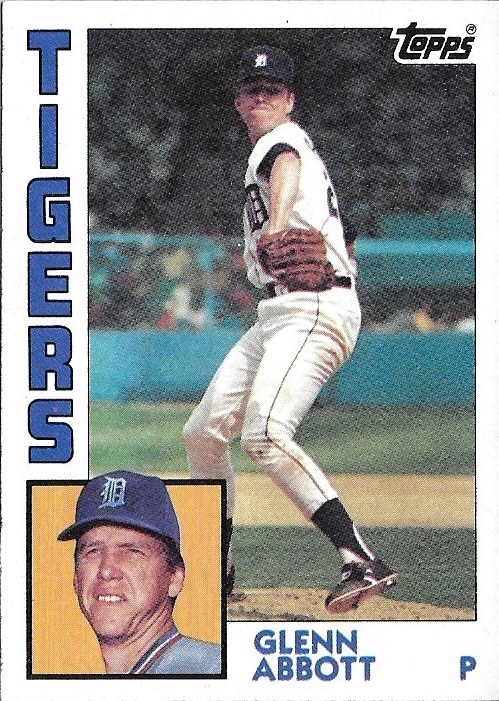
After eight scoreless extra innings, the Indians broke through in the 19th, dropping four runs on Abbott — who was in his fifth inning of relief.
The Tigers made four errors in the game.
Had the game remained tied after the 19th, under American League rules, it would have been suspended.
This was also the night of the epic Pistons/Knicks Game 5 playoff game held at Joe Louis Arena due to the Silverdome’s collapsed roof. Isiah scored 16 points in 94 seconds in the fourth quarter to force OT … but the Pistons lost 127-123.
Miscellany
Venue: Tiger Stadium
Umpires: HP – Rocky Roe, 1B – Larry Barnett, 2B – Dale Ford, 3B – Ken Kaiser
Umpires: HP – Al Clark, 1B – Don Denkinger, 2B – Dan Morrison, 3B – Mike Reilly
Time of Game: 2:38
Attendance: 25,883
Bill Krueger #30
Here are a few things to know about lefty Bill Krueger:
Bill Krueger, not displaying his tremendous high leg kick.
The Tigers signed Krueger on Dec. 11, 1992. He spent the ’92 season with the Twins and Expos.
He made his Tigers debut on April 7, 1993 against his original club, the A’s, in a 12-7 Tigers loss. His line: 3.1 IP, 5 hits, 2 runs, 3 walks and 3 strikeouts.
The 1994 Tigers were not good and Krueger’s year aligned with his team’s. He had appeared in 16 games — his last a June 2 start against the Orioles in Baltimore — before the Tigers released him on June 4, with an 0-2 record and a 9.61 ERA.
Bill Krueger’s final line in Detroit: 6-6 with a 4.60 ERA.
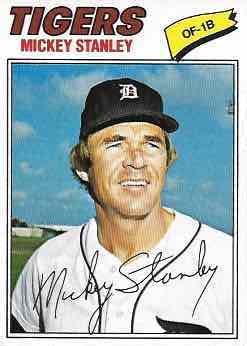
For many fans, Mickey Stanley’s defining moment with the Tigers came in the 1968 World Series when manager Mayo Smith shifted him from the outfield to shortstop — a position he’d played only in nine major-league games.
The move was made specifically to keep Al Kaline in the lineup while adding some pop to the ’68 team’s woeful production at shortstop. Ray Oyler played most at short that year (111 games) but hit just .135, while backups Tom Matchick and Dick Tracewskicombined hit .180 (!).
In his terrific bio on Stanley, which appears in the 2008 book Sock It to ‘Em Tigers, Jerry Nechal sums up the new shortstop’s performance in the Series against the Cardinals:
Obviously a quick learner, Stanley went on to amaze the baseball world in the Series. In the first inning of Game 1 he was tested by a leadoff ground ball off the bat of the speedy Lou Brock. Brock was out on a close play and Mickey’s fielding at shortstop became a nonfactor. He successfully handled 30 of 32 chances, making two inconsequential errors.
Mickey Stanley broke in with the Tigers on Sept. 13, 1964, singling in his first at bat off Claude Osteen, and appeared in just four games that season. He played in 30 games the following season before making the big club out of Spring Training in 1966, and soon became a fixture in centerfield for the Tigers until a speedy rookie Ron LeFlore took over in the mid-’70s.
My greatest memory of Stanley comes from Aug. 10, 1977, the first Tigers game I ever attended.
The starting pitcher for the Tigers was rookie Jack Morris who would pitch 7.2 innings on the way to his first major-league win, but he wouldn’t have gotten the win that night without a dazzling play by Stanley with two out in the ninth inning.
With Von Joshua at first, Cecil Cooper stood at the plate as the potential tying run. He launched a pitch from Steve Foucault deep to right field and from my lower deck seats on the first base side, it looked like it would indeed tie the game. Instead, Stanley timed his jump and took away a home run, securing a 5-3 win for the Tigers — and Morris.
And it took no time for me to decide who my favorite Tigers were.
Mickey Stanley retired after the 1978 season, his 15th, after playing in 1,516 games — all with the Tigers.
As I told my pal Doug, add 100 to my rarity score because. out of frustration, I looked at the 1977 Mariners roster to see who I remembered as a Cardinal. For kicks, I dropped him in to see how rare it was — rare!
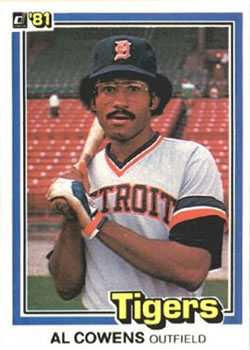
But Cowens was an intriguing player to me because he was on those great Royals teams in the late-’70s.
Presumably the Tigers and Angels, at the time of the trade, thought a change of scenery would help both players — and it seemed to work.
Cowens was hitting .227 with the Angels with a homer, 17 RBI and a .597 OPS. As a Tiger, he hit .280 in 108 games, with five homers, 42 RBI and a .709 OPS. All told, his 1980 line was: .268, six homers, 59 RBI and a .684 OPS.
Thompson hit just .214 with four homers, 20 RBI and a .638 OPS, in Detroit, but warmed up quickly in Anaheim: .317, 17 home runs, 70 RBI and a .965 OPS. He finished the year at .288, 21 home runs, 90 RBI and .873 OPS.
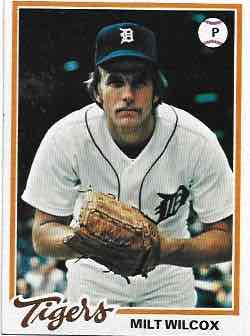
Thompson went 1 for 4 with a single off Milt Wilcox.
*Thompson made his Angels debut on May 28 against the Rangers, pinch hitting for catcher Tom Donohue. He hit a bases-loaded double off Sparky Lyle, clearing the bases, and scored when Dickie Thon drove him home.
In 1981, Cowens appeared in 85 games for the Tigers, hitting .261 with one home run, 18 RBI and a .667 OPS … and that was it for his time in Detroit.
On March 28, 1982, the Mariners purchased his contract and he had a nice bounce-back year in Seattle, hitting .270 with 20 home runs, 78 RBI and an .800 OPS.
I spent the day at Camelback Ranch, the spring training home of the Dodgers and White Sox, watching my alma mater, Western Michigan, come from ahead to beat Michigan, 11-9 in 10 innings.
Imagine my surprise when I noticed that former Tiger Daniel Schlereth is the Broncos’ pitching coach.
Here’s the final out.
Western Michigan vs. University of Michigan — Camelback Ranch, Glendale, Ariz. February 17, 2024




 dailyfungo.com