Umpires: HP – Dan Morrison, 1B – Marty Springstead, 2B – Jim McKean, 3B – Durwood Merrill
Time of Game: 3:06
Attendance: 8,497
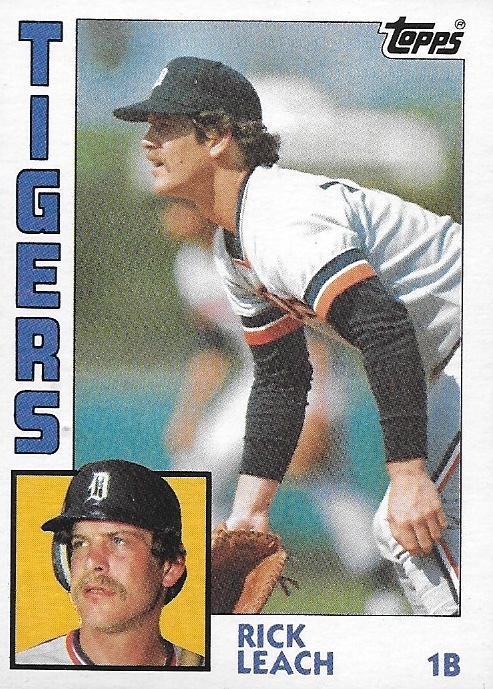
Rick Leach #7
Here are seven things to know about Rick Leach, who went from start Michigan quarterback to Tigers first baseman.
He was drafted by the Tigers in the first round (13th) of the 1979 MLB June Amateur Draft from University of Michigan. He was previously drafted by the Phillies twice: in the 11th round of the 1975 draft from Flint Southwestern High, and in the 24th round of the 1978 draft from Michigan.
On May 6 in Oakland, Leach got his first big-league start: batting seventh and place first. He finished 0 for 1 that night, but with three walks. The following day, he got his first major-league hit, a single to left off Matt Keough that drove in Champ Summers.
Leach saw his playing time increase between 1981 and 1983, appearing 54, 82 and 99 games respectively. His best year was 1983: .248, three home runs and 28 RBI.
With Dave Bergman, Bárbaro Garbey and Darrell Evans all slated for playing time at first, the Tigers released Leach on March 24, 1984 — the same day of The Trade that brought Bergman and Willie Hernandez to Detroit. And he signed, with of all teams, the Blue Jays. (He appeared in only two games against the Tigers.)
Leach had his best years in Toronto. In five seasons, he batted .283, eight home runs and 95 RBI.
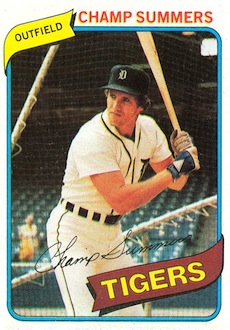
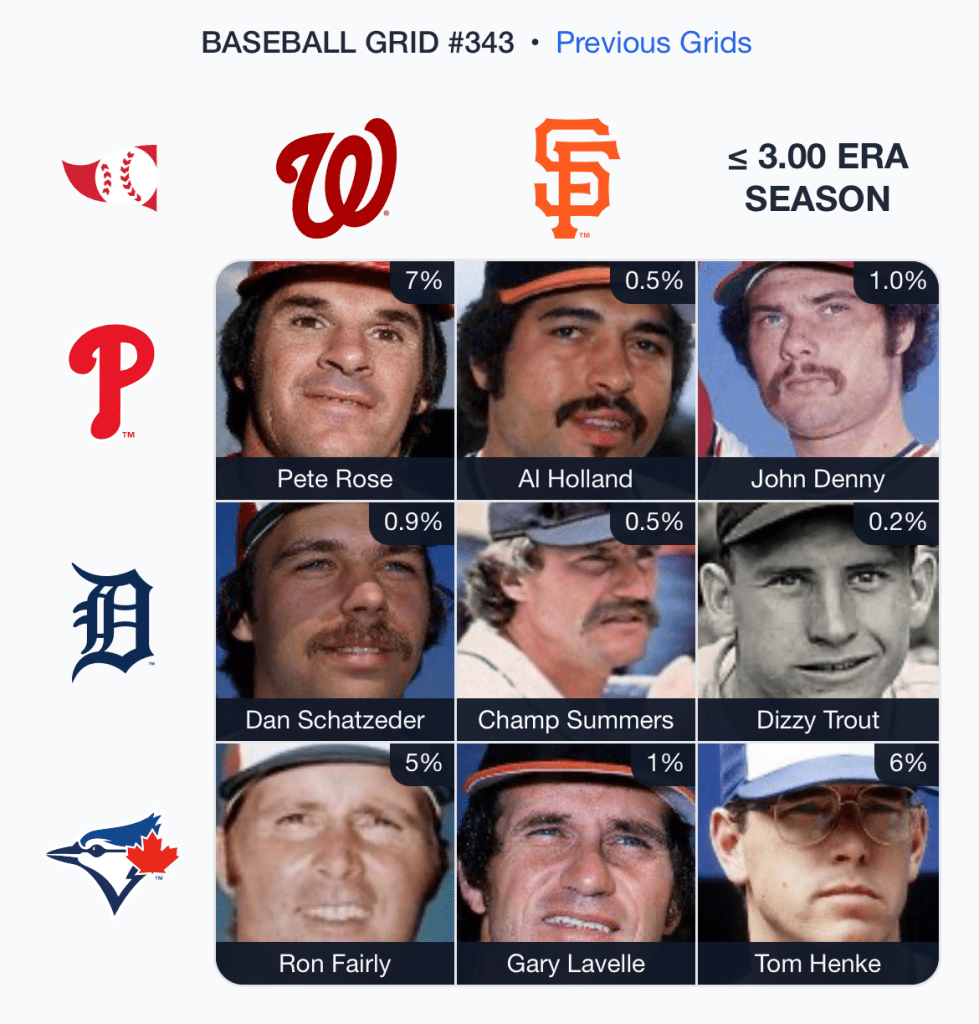
Champ Summers was a fan favorite in Detroit and for good reason. He came to the Tigers as a career underachiever — at least at the major-league level — in an under-the-radar trade roughly a week before they hired Sparky Anderson in 1979.
The Reds traded the 30-year-old Summers to the Tigers for a player to be named later on May 25, 1979. On Oct. 25, the Tigers sent Sheldon Burnside to the Reds to complete the trade.
The year before, John Junior Summers was the Minor League Player of the Year for the Reds’ top farm club, Indianapolis of the American Association. He led the AA with a .368 average, 34 homers and 124 RBI.
In 1979, Summers was hitting .200 with a single home run after 27 early-season games with the Reds, but after coming to Detroit, he had the best three seasons of his career.
That season he batted .313 with 20 home runs (14 solo) in 90 games and posted a .614 slugging percentage along with a 1.028 OPS. Anderson played Summers primarily in right field with a few DH assignments sprinkled in.
The Tigers rewarded him with a three-year contract near the end of the ’79 season.
Tigers fans loved Summers and he continued to provide punch to a young lineup. In 1980, his numbers slipped ever-so slightly but they were solid: .297/17/60 with an OPS of .897.
His production dropped further in the strike-shortened season of 1981 when, at age 35, his average fell to .255 and his power numbers plummeted, too. Summers hit only three home runs and eight doubles in 64 games in what would be his final season in Detroit.
In March 1982 the Tigers dealt him to the Giants for first baseman Enos Cabell. Summers would struggle in his two seasons in San Francisco, posting a .231 average and four home runs.
On this date in 1983, George Kell was elected to the Hall of Fame by the Special Veterans Committee. Former Brooklyn and Los Angeles Dodgers manager Walter Alston was elected too.
My friend Doug and I attended this game, sitting in the centerfield bleachers for budgetary reasons, and choosing the lower deck for meteorological.
‘Twas a soggy day for the finale of a three-game set that, at the outset, provided foolish hope the Tigers could gain ground on the Red Sox, which entered the series four-and-a-half games up on second-place Detroit.
Instead, the Tigers were swept and this one ended with an eighth-inning bullpen collapse.
Neither Roger Clemens nor Walt Terrell were sharp: Clemens allowed seven hits, five walks and three earned runs in six innings. Terrell: six hits, three walks and four earned in seven innings.
The Red Sox led 4-0 until the Tigers scored two in the sixth, on a two-run homer by Alan Trammell, and Darrell Evans grand slam in the seventh to go up 6-4.
Bill Campbell (three) and Willie Hernandez (two) coughed up five runs in the top of the eight and Boston held on to win.
Rich Gedman hit a grand slam off Willie; two of the runs were charged to Campbell.
From 1983 to ‘84, he appeared in 47 games for the Reds. On April 26, 1985 the Reds sent him to the Expos for Max Venable. He appeared in 19 games for the ‘85 Expos.
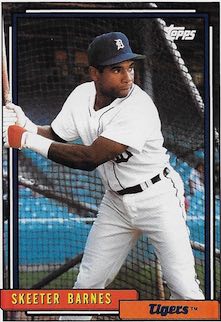
Barnes saw no major-league action in 1986, and on July 24 he was traded, with former Tiger Dan Schatzeder, to the Phillies for Tom Foley and Lary Sorensen.
In 1987, he signed with the Cardinals but only appeared in four games. After spending 1988 in Triple A, he appeared in five games for the Reds.
Then, on Jan. 21, 1991, he signed with the Tigers. After starting the year in Toledo, Barnes made his Detroit debut with gusto on June 14, in a 5-1 win in Seattle. He hit a solo homer in his first Tigers at bat, off Brian Holman, with two out in the first inning.
Sparky used him just about everywhere: 1B, 2B, 3B, Shortstop, all outfield spots.
From ’91 to ’94, he appeared in 278 games for the Tigers batting .281 with 11 homers, 73 RBI and a .739 OPS.
Acquired: Traded by the Reds to the Tigers for a player to be named later on May 25, 1979. The Tigers sent Sheldon Burnside to the Reds to complete the trade October 25, 1979.
Seasons in Detroit: 3 (1979-81)
Bats: Left Throws: Right
Height: 6′ 2″, Weight: 205 lb.
Uniform Number: 24
Stats: .293 avg., 40 HR, 132 RBI, .896 OPS
Champ Summers was a fan favorite in Detroit and for good reason. He came to the Tigers as career underachiever — at least at the major-league level — in an under-the-radar trade roughly a week before they hired Sparky Anderson in 1979.
The year before, John Junior Summers was the Minor League Player of the Year for the Reds’ top farm club, Indianapolis of the American Association. He led the AA with a .368 average, 34 homers and 124 RBI.
It was in the majors, though, where Summers struggled to out together a career — and it wasn’t from a lack of opportunities. After debuting with the A’s in 1974 — a team with a loaded outfield featuring Reggie Jackson, Joe Rudi, Rick Monday and Bill North, among others — he spent two seasons with the Cubs (hitting only .217 with four home runs). Next up was parts of three seasons with the Reds … and a .199 average.
In 1979, Summers was hitting .200 with a single home run after 27 early-season games with the Reds. But on May 25, the Reds sent him to the Tigers and, at the age of 30, he began the best three seasons of his career.




 dailyfungo.com