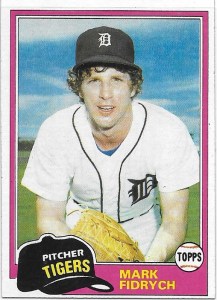
Fifty-two Detroit Tigers have worn number 20, and it’s currently worn by Spencer Torkelson. But the first player I remember wearing number 20 was Mark Fidrych from 1976 to 1980.
Howard Johnson, 1983-1984. HoJo originally wore number 5, but it was retired during the ‘83 season (along with number 2*) to honor Hank Greenberg and Charlie Gehringer, respectively.
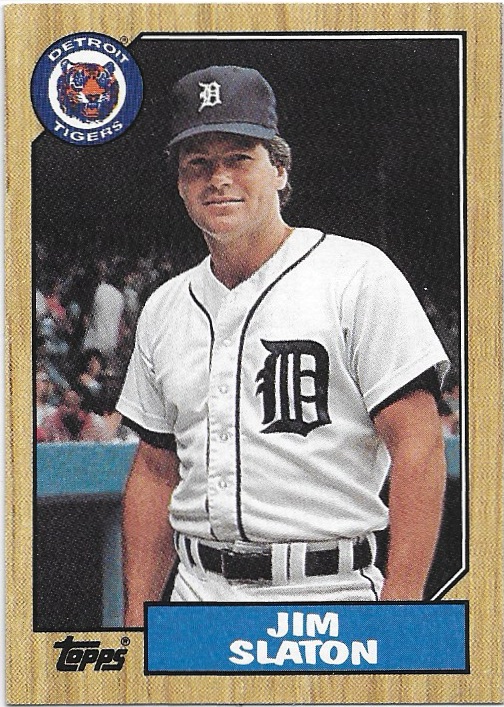
Jim Slaton, 1986. Slaton first pitched for the Tigers in 1977 and he wore number 21. When he returned in ‘86, he wore 20 and then changed to number 40.
The Tigers were up 7-0 in third inning and banged out 12 hits off five Blue Jays pitchers. Berenguer eked out a five-inning win, allowing three hits, two runs and striking out four.
The Tigers likely savored the off day after all the doubleheaders. Let’s look ahead 10 years to a markedly different brand of Tigers baseball played in 1994. 😬
Easter Sunday’s cold and rainy weather in Detroit persisted and the Tigers and Twins face a doubleheader on April 24.
Record: 12-1
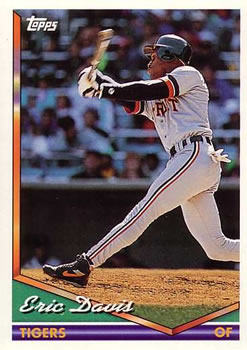
Eric Davis – #33
The 1993 season was a weird one. From April 23 to June 25, the Tigers were either in first place or tied for the division lead.
Then, beginning June 23, they lost 10 in a row and 13 of 14. The next thing you know, they were 4.5 games back by July 1.
On Aug. 31, sitting in third place and six games back of the Blue Jays, the Tigers made a curious and intriguing deal with the Dodgers, acquiring former All-Star outfielder Eric Davis for a player to be named later.
Davis was a superstar with the Reds and was traded to Los Angeles in December 1991 and re-signed with his hometown team in November 1992. He didn’t match the dual-threat production he had in his first eight seasons* in Cincinnati — 177 homers, 247 stolen bases — so at the Aug. 31 traded deadline, the former Gold Glover was sent to Detroit.
He debuted with the Tigers on Sept. 3 at Tiger Stadium against the White Sox. Sparky slotted him in the seven spot, in centerfield. He doubled in his second at bat and homered in the bottom of the eighth — a three-run shot to draw the Tigers to within two, 8-6. That was the final score.
Davis’s 1993 Detroit totals: 23 games, six homers, .253 average and a .904 OPS. He also stole two bases, bringing his L.A./Detroit combo to 35.
As for the Tigers, they finished tied for third, 10 games back of Toronto.
The Tigers brought Davis back in 1994, but injuries limited him to just 37 games. He batted .183 with three home runs.
All told, his 60-game Tigers career wrapped with a .210 average, nine home runs, seven stolen bases and a .706 OPS.
*After sitting out 1995, he returned to the Reds for one more season in 1996, and then had a post-cancer resurgence with the Orioles, Cardinals and Giants.
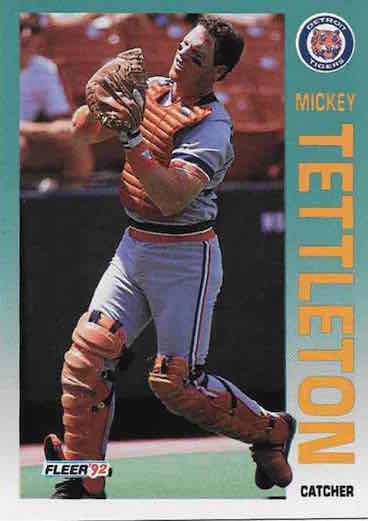
Who didn’t like Mickey Tettleton? He was built like a tank, stood ramrod straight at the plate and could crush the ball from either side. And, he was solid defensively.
Tettleton came to Detroit from the Orioles in a steal of a trade for the once-promising righty, the late Jeff Robinson.
Why would the Orioles, who weren’t exactly brimming with offensive talent, want to part ways with Tettleton?
According to this story, they “did not want to pay him more than $1 million to be backup to Bob Melvin.” Bob Melvin! And shortly thereafter his ticket to Detroit was punched.
“He has good defensive skills and is adept at working with pitchers,” acting Tigers General Manager Joe McDonald said. “In addition, he brings even more punch to our lineup.”
He averaged 32 homers in his first three years with the Tigers … and 136 strikeouts. But, he also averaged 110 walks over those three seasons including a league-leading 122 in 1992.
Sparky penciled him in primarily at catcher in 1991 and ’92, with a few dozen starts at designated hitter. In 1993 and ’94, Tettleton began to see more time at first base and the outfield.
Tettleton and Tiger Stadium were a perfect fit: More than half his homers as a Tiger came at home.
After the strike-shortened 1994 season, he was granted free agency by the Tigers. He signed with the Rangers just before the 1995 season began and played parts of three seasons in Arlington before retiring in July 1997, with 245 career home runs.
Lately I’ve been giving a lot of thought to who my all-time favorite Tigers are and who would make a tidy list.
Putting together my top 10 would be easy. Narrowing it to just five would be tough but I wanted to give it a shot.
What’s the criteria for this list?
I decided that this was my purely subjective list based on players I enjoyed watching play for the Tigers.
For example, Mark Fidrych doesn’t make the list simply because I never saw him play live — and I decided ESPN Classic and MLB Network reruns don’t count.
The legend of The Bird and his place in Tigers lore is secure for me.
Here’s my list* — not in order of favorite-ness, but in order of how they came to mind — which has been revised right up to the moment I clicked “Publish” on this post.
Acquired: Traded by the Orioles to the Tigers for Jeff Robinson on Jan. 11, 1991.
Seasons in Detroit: 4 (1991-94)
Uniform Number: 20
Stats: .249 avg., 112 HR, 333 RBI, .867 OPS
Awards: Silver Slugger (1991, ’92) All Star (1994)
Who didn’t like Mickey Tettleton? He was built like a tank, stood ramrod straight at the plate and could crush the ball from either side of the plate. And, he wasn’t half-bad behind the plate.
Tettleton came to Detroit in a steal of a trade from the Orioles 20 years ago next week, the Tigers sending once-promising righty Jeff Robinson to Baltimore in the deal.
After four nondescript seasons with the A’s in which he never hit more than 10 home runs, Tettleton was released by Oakland and signed by the Orioles at the end of March 1988. That season he hit 11 homers but struck out 117 times in 411 at bats.
In 1989, however, he became a dangerous hitter, clubbing 26 homers and earning an All-Star appearance. And while his strikeouts rose along with his plate appearances, so did his walks. In 1990, he fanned 160 times (a career high) but walked 106.
Why would the Orioles, who weren’t exactly brimming with offensive talent, want to part ways with Tettleton? According to this story, they “did not want to pay him more than $1 million to be backup to Bob Melvin.” Bob Melvin! And shortly thereafter his ticket to Detroit was punched.
“He has good defensive skills and is adept at working with pitchers,” acting Tigers General Manager Joe McDonald said. “In addition, he brings even more punch to our lineup.”




 Tettleton came to Detroit in a steal of a trade from the Orioles 20 years ago next week, the Tigers sending once-promising righty Jeff Robinson to Baltimore in the deal.
  dailyfungo.com