
The Monday Fungo

Mickey Tettleton – #20
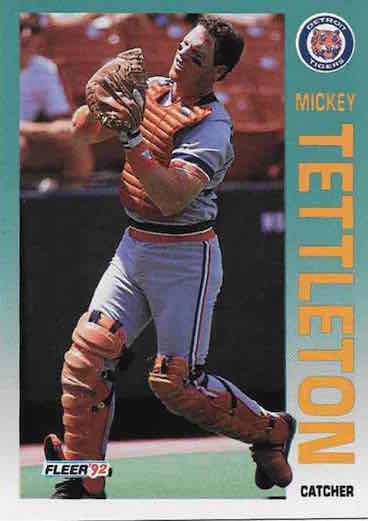
Who didn’t like Mickey Tettleton? He was built like a tank, stood ramrod straight at the plate and could crush the ball from either side. And, he was solid defensively.

Tettleton came to Detroit from the Orioles in a steal of a trade for the once-promising righty, the late Jeff Robinson.

Why would the Orioles, who weren’t exactly brimming with offensive talent, want to part ways with Tettleton?

According to this story, they “did not want to pay him more than $1 million to be backup to Bob Melvin.” Bob Melvin! And shortly thereafter his ticket to Detroit was punched.

“He has good defensive skills and is adept at working with pitchers,” acting Tigers General Manager Joe McDonald said. “In addition, he brings even more punch to our lineup.”

And how.

Tettleton joined a Tigers roster full of mashers: Cecil Fielder, Rob Deer and Pete Incaviglia.

  • He averaged 32 homers in his first three years with the Tigers … and 136 strikeouts. But, he also averaged 110 walks over those three seasons including a league-leading 122 in 1992.
  • Sparky penciled him in primarily at catcher in 1991 and ’92, with a few dozen starts at designated hitter. In 1993 and ’94, Tettleton began to see more time at first base and the outfield.
  • Tettleton and Tiger Stadium were a perfect fit: More than half his homers as a Tiger came at home.

After the strike-shortened 1994 season, he was granted free agency by the Tigers. He signed with the Rangers just before the 1995 season began and played parts of three seasons in Arlington before retiring in July 1997, with 245 career home runs.

Birthdays

Will Rhymes and the late Rusty Staub, Ron Perranoski, Frank Castillo, Moe Franklin, Jake Wade

Today’s Grid

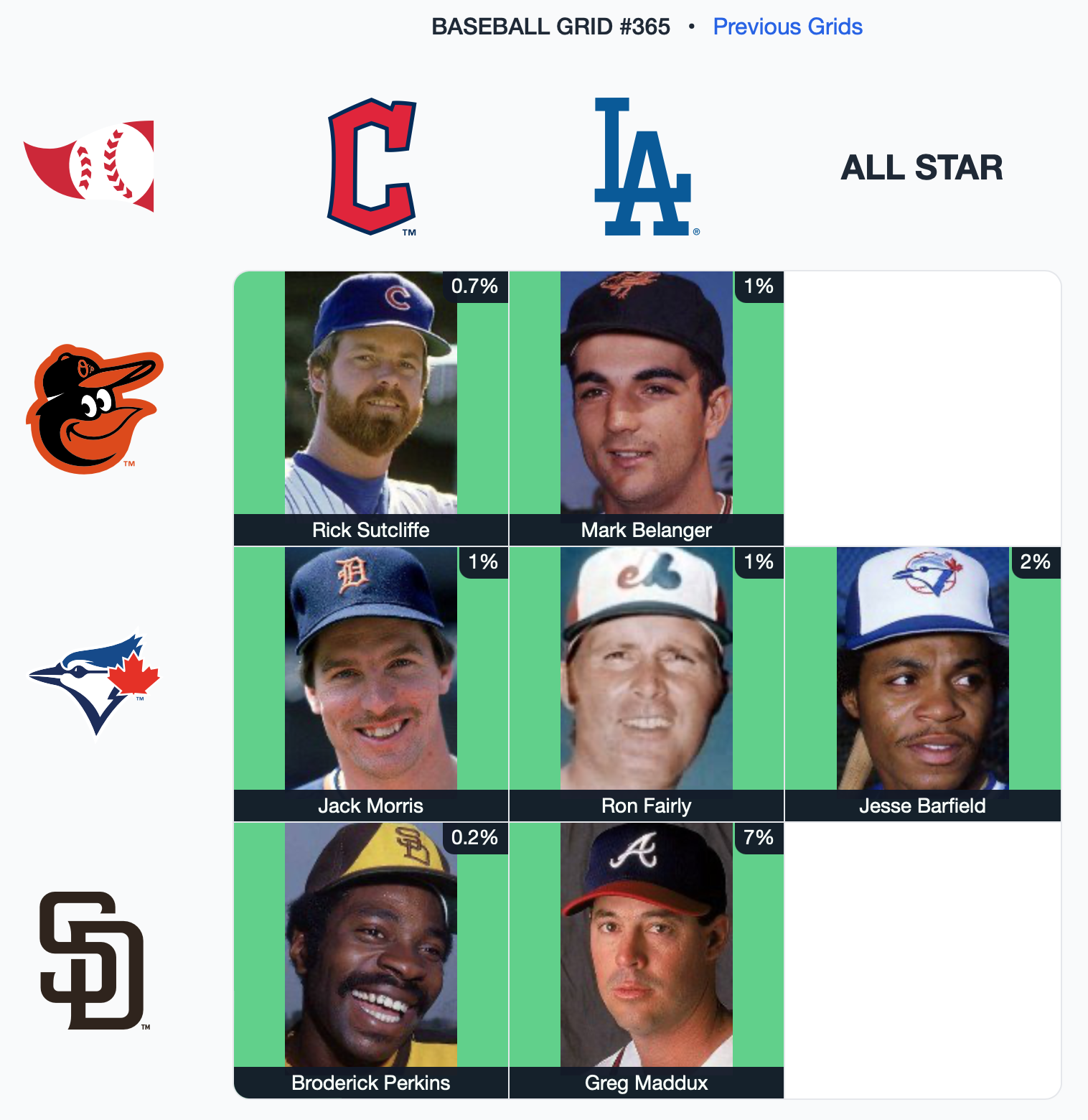
⚾️ Immaculate Grid 365 7/9 — Rarity: 213

I was overdue for a stinker. I still managed to work Jack Morris into it.
See you tomorrow.

2012 Top 10 Stories: #8 – The Black Hole at Second Base

Remember when Scott Sizemore was the answer to the Tigers’ second base question? After nearly five seasons of Placido Polanco’s wizardry at second, and in the number-two slot of the lineup, the Tigers tried to convince fans – and maybe themselves – that Sizemore could take over with gusto.

After 65 games spread across two seasons, Sizemore was dealt to Oakland and suddenly second base became a giant black hole. Again.

In 2010, Carlos Guillen and Will Rhymes both played more games at second than Sizemore, fully cementing the second-base-by-committee approach.

Last season, Ryan Raburn made his play for the job, appearing in 56 games at second and committing 10 errors in 201 chances. Backed by his usual second-half surge, he convinced the Tigers he could hold down the job full-time in 2012.

The assumption, naturally, was that Raburn would hit enough to mask some lead-gloved D. (The same was said of Prince Fielder, Miguel Cabrera and, to a lesser degree, Jhonny Peralta.)

Except, he didn’t hit well enough to warrant a job anywhere on the diamond. Neither did Plan B, Ramon Santiago.

Combined, Plan A and Plan B hit .189.

That’s why, as the July 31 Trade Deadline inched closer, the Tigers were linked to every available second baseman in the majors: from Darwin Barney to Kelly Johnson to the man the landed on July 26 along with Anibal Sanchez: the prodigal son Omar Infante.

Having a full-time second baseman certainly settled the lineup but Infante look anything but settled at times, at least defensively after his arrival. He made nine errors in 267 chances over 61 games at second, At the plate, he hit .257: 80 points higher than Raburn and 50 more than Santiago.

Heading into 2013, Infante is the incumbent at second and in the final year of his contract. Given the slim pickings in the Tigers’ minor-league system, a solid first half could earn the 31-year-old Infante a contract extension and make him the second baseman for the foreseeable future … just as he was in 2001.

Go figure.

The Top 10 Stories of 2012