
 Edwin Nunez turns 45 today.
Remember him?
He pitched in 69 games for the Tigers in 1988 and ’89, earning a 6-5 record with seven saves.
Looking back on it, I would’ve guessed he’d pitched in a lot more games than that.
Edwin Nunez turns 45 today.
Remember him?
He pitched in 69 games for the Tigers in 1988 and ’89, earning a 6-5 record with seven saves.
Looking back on it, I would’ve guessed he’d pitched in a lot more games than that.
Happy 61st (?!) Birthday to ol’ #41 Darrell Evans.
Before Pudge Rodriguez and Magglio Ordonez, the Tigers’ big splash in the free agent market came on Dec. 17, 1983, when they signed the 36-year-old slugger.
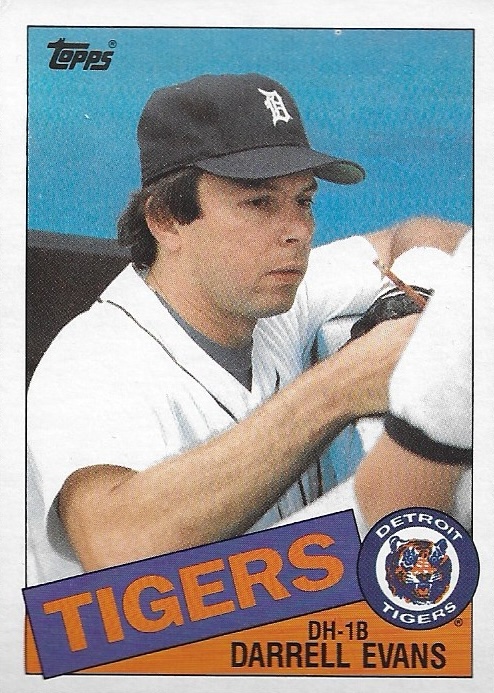
As most seasoned Tigers fans remember, the free agency was anathema to the club’s leadership. Former Tigers GM Jim Campbell hated paying for his own free agent players — and loved to trade them before their walk year. He certainly wasn’t going to dole out cash for someone else’s players.
I can distinctly remember the old “re-entry draft” which created a competitive auction market for the services of veteran players. The Detroit News and Free Press would list, usually in agate type, each team and the free agents it “drafted.” Year after fifth-place year I would read “Detroit: No selections made.”
That changed in 1983 when Evans chose a Detroit offer which was, of course, lower than those of the Yankees, Giants and other clubs that tried to sign, or in the case of San Francisco, re-sign him. The allure of joining a team poised to win now (or then, as it were) made Detroit the best choice.
In his first game as a Tiger, April 3, 1984, Evans homered of the Twins’ Keith Comstock — a three-run jack — and Detroit was off to the races. A week later, on Opening Day in Detroit, he homered in his first Tiger Stadium at bat, an upper-deck blast of the Rangers Dave Stewart. He’d hit only 14 more home runs that year, but quickly became a fan favorite.
In five seasons with the Tigers, Evans hit 141 of his career 414 home runs. In 1989, he finished his career where it began: with the Atlanta Braves.
Today’s Tigers fans may be used to their team being in the mix for big-name free agents. But it certainly wasn’t the case in the late 1970s and early ’80s. And what better guy to break that bad habit than with Darrell Evans?

…When, on May 14, we failed to acknowledge the 57th birthday of former Tigers infielder Stan Papi.
The Tigers purchased Papi’s contract from the Phillies on May 29, 1980 and he made an immediate splash in Detroit.
On Friday, May 30 against the Angels, Papi started at second base and batted ninth (behind the number-eight hitter, Kirk Gibson).
He struck out against Frank Tanana in the bottom of the second but in the fourth smacked a two-run home run of Tanana to give the Tigers and Milt Wilcox a 4-1 lead. He singled in his next at bat and then tripled in the sixth off Jim Barr. The Tigers won the game 12-1.
Papi finished the 1980 campaign with a .237 average, three homers and 17 RBI in 46 games. He hung around for 40 games in the strike-shortened 1981 season, hitting just .204.
His last appearance in a big-league game came on Oct. 1, against the Orioles at Tiger Stadium. Sparky inserted him as a pinch hitter for Rick Leach in the seventh; Papi struck out against Tippy Martinez to end the inning.
…the Tigers acquired outfielder Russ Nagelson and lefty Bill Rohr from the Indians for RHP Fred Lasher.
Nagelson appeared in 28 games for the Tigers that year, his last in the bigs, and batted .188.
Rohr never appeared in a game for Detroit.
After his trade to Cleveland, Lasher went 1-7 with a 4.07 ERA in 43 appearances.
Not exactly a blockbuster.
When you search for “raw deal” on Google, the first entry is for the 1986 film by the same name starring Arnold Schwarzenegger, Kathryn Harrold and Darren McGavin.
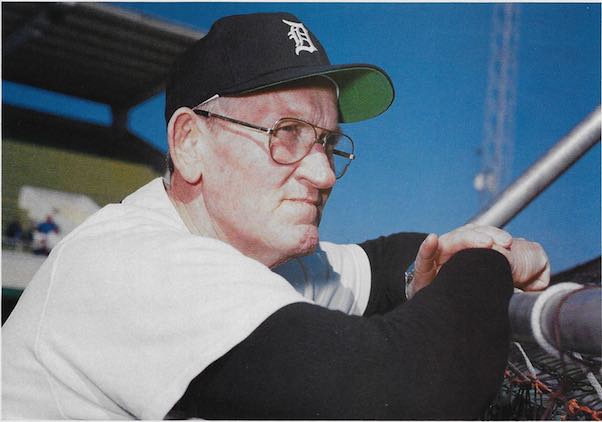
Twenty-nine years ago Les Moss got a raw deal in his second big-league managing job.
Yes, second. He managed the 1968 White Sox for just 36 games, going 12-24.
In 1979, John Lester Moss took over for the retired Ralph Houk as Tigers manager. Moss had been in the Tigers farm system managing the Triple-A Evansville (Ind.) Triplets in the American Association and it was, I guess, his turn.
Moss managed the Tigers for just 53 games in ’79. Detroit sat at a 27-26, on the morning of June 14. Before Moss could order lunch, he was out of a job and Sparky Anderson was the Tigers’ new manager. (Officially, first base coach Dick Tracewski was the interim manager. Trixie led the Tigers to a 2-0 record before Sparky took over.)
So the Moss Era was over before it even began. The managing era, that is.
Did you know that Les Moss had a 13-year career as a catcher in the majors? He debuted in 1946 as a 21-year-old with the St. Louis Browns. He played in just a dozen games that year but finished a .371 average.
A review of his year-by-year stats show one thing: he was ridiculously inconsistent. For example:
…and so on. What else?
Though he didn’t hang around Detroit for very long, Les Moss is another player in the Tigers’ rich history.
Today the Tulsa native turns 83.
**Update: Moss passed away Aug. 29, 2012.

How in the world did Lou Whitaker turn 50 — forget about 51, which he is today? Lest we’ve forgotten, let’s take a quick stroll down memory lane on his 19-year career with the Tigers:
If you’re keeping score at home, Whitaker averaged a hit a game over his career. (Actually he averaged .991 hits a game, but when it’s your birthday, you benefit from rounding up.)
And how is he not in the Hall of Fame? Jeez!
Notable Hardware
Here’s hoping that Sweet Lou enjoyed his birthday at home in Lakeland, Fla., or a local theme park.

You are one die-hard Tigers fan if you remember right hander Dan Gakeler.
It’s scary because I remember him.
A former number-one pick of the Red Sox in the 1984 draft (secondary phase), Gakeler appeared in 31 games for the 1991 Tigers, seven of them were starts.
Wearing the number 32, he assembled a record of 1-4 with two saves and a 5.74 ERA.
Happy 44th Birthday, Dan.
No?
He appeared in 18 games for the 2005 Tigers (5-5, 5.56 ERA).
Ring a bell?
Anyway, he turns 29 today.
I remember it clearly: April 15, 1983.
It was a freezing cold day in Detroit just like it was at Comiskey Park. Making matters worse, the Tigers and White Sox were playing at night. (Imagine last Friday night’s game in Chicago — only colder and without the precipitation.)
The Tigers’ Milt Wilcox pitched the game of his life against the White Sox’s pot-smoking and eventual Cy Young Award-winning LaMar Hoyt (or according to Baseball-Reference.com, “La Marr Hoyt”). And to this day, it was the most meticulously pitched game I’ve ever seen … though Mike Mussina‘s near-perfecto against Boston in 2001 was darned close.
Twenty six Chicago batters up, 26 down. More on that in a moment.
According to Retrosheet.org, here is Detroit’s lineup from that night:
And, the White Sox’s:
For me, there are many fascinating things about the Tigers’ lineup that night — Howard Johnson batting second and playing third base, Glenn Wilson in right, Rick Leach at first — but none more fascinating than Alan Trammell hitting ninth.
The story on this night 25 years ago was Milt Wilcox.
Wilcox’s Road to the Majors
The Honolulu native was drafted by Cincinnati in the second round of the 1968 amateur draft. He debuted with the Sparky Anderson-managed Reds in 1970 at the age of 20, posting a 3-1 record and a 2.42 ERA.
Sparky would earn a reputation for having little tolerance for youngsters on his team. Apparently he didn’t feel that way in 1970 because he pitched Wilcox in the NLCS and World Series that year. He struck out five in just three innings of the LCS against the Pirates allowing only one hit.
The Orioles fared a tad better against Wilcox in the World Series. In two appearances (just two innings pitched), he allowed three hits, two earned runs, two walks and a pair of strikeouts.
After the 1971 season, Wilcox was traded from the Reds to Cleveland for outfielder Ted Uhlaender. After three mostly forgettable seasons with the Indians, he was dealt to the Cubs for pitcher Dave LaRoche and outfielder Brock Davis. Wilcox appeared in only 25 games for the Cubs in 1975 and spent the Bicentennial Year in the bushes.
Welcome to Detroit
On June 10, 1976, the Tigers purchased his contract from the Cubs and his career began to stabilize. From 1977-84, Wilcox was a mainstay in the Tigers’ rotation, averaging 22 starts and nearly eight complete games a year.

But none of his 72 other complete games could compare to the frigid night on the South Side.
26 Down…
Wilcox, wearing number 39, cruised through the first 26 batters with only a couple minor scares — a Tony Bernazard dribbler up the middle in the first that Trammell turned into an out and then a Harold Baines low liner to Herndon in the bottom of the seventh.
In the bottom of the ninth, Carlton Fisk flied out to left on the first pitch. Then Mike Squires, a Western Michigan University product, pinch-hit for Vance Law and promptly grounded out to Leach at first.
Chicago manager Tony LaRussa replaced Jerry Dybzynski with another Jerry, Jerry Hairston
On Wilcox’s first pitch, Hairston grounded a single to center for Chicago’s only baserunner of the night. (And I can still hear George Kell crying out: “Wouldya believe it!“)
The next hitter, Rudy Law, bounced out to Leach to end the game. The Tigers won 6-0, but Wilcox lost a chance at the Hall of Fame.
Here’s what Wilcox told the Free Press‘s Mike Downey:
“I was nervous the whole game,” Wilcox said later. “Pitching a perfect game puts you in the Hall of Fame. That’s the only way I’m going to get there.”
Here’s the final pitching line that night:
Wilcox: 9 IP – 1 H – 0 R – 0 ER – 0 BB – 8 SO – 0 HR
Less than a year later, in the same park and in similar conditions, Jack Morris would throw his no-hitter; perhaps using the leftover karma from Wilcox’s gem.
Though officially it was Hairston’s single that broke up the perfect game, perhaps there was some friendly fire jinxing going on in the Tigers dugout.
Again from Downey’s column:
“I heard them talking about it on the radio,” Wilcox said, and “(Kirk) Gibson said something to me in the fifth inning. I wasn’t worrying about being jinxed. I was worried about finishing the game.”
So much for Gibson following tradition.
Winding Down a Career
Wilcox would finish the 1983 season with a 11-10 record and a 3.97 ERA. His highest win total would come the next year when he finished at 17-8, 4.00 ERA.
His last season in Detroit was an abbreviated one. Arm trouble caused him to shutdown with a 1-3 record and a 4.85 ERA in 1985. The Tigers released him on Dec. 20 that year.
The Mariners signed Wilcox on Feb. 5, 1986. He appeared in 13 games for Seattle that season before being released on June 14 with a 0-8 record and a 5.50 ERA.
In 1984, Wilcox won a game in the ALCS and the World Series (I attended both games). But for most Tigers fans, his defining moment will be his flirtation with a perfect game a quarter-century ago.
In case you’d forgotten, it was 24 years ago this week that the Tigers swung a deal with the Phillies that changed the 1984 season for the Tigers dramatically — and instantly.
On March 27, 1984, the Tigers acquired lefty reliever Willie Hernandez and first baseman Dave Bergman from Philadelphia in exchange for OF Glenn Wilson (my favorite Tiger back then) and all-purpose guy John Wockenfuss.
With World Series expectations higher than perhaps ever in Tigers history and the team searching, as it was in 1984, for bullpen reinforcements, let’s look back on a trade for the ages.
There was no reason to expect the moon from Willie Hernandez as the Tigers’ new closer. After his trade to the Phillies from the Cubs on May 22, 1983, he went 8-4 with a 3.29 ERA and seven saves in 63 appearances, primarily as a setup man for closer Al Holland.
But, as if I need to remind you, in 1984 Hernandez put together the career year to end career years: 9-3, 32 saves, 1.92 ERA, 80 appearances, 140 IP, All Star, American League Cy Young Award winner and Most Valuable Player.
Sparky had lots to say about Willie Hernandez in his book about the ’84 season, Bless You Boys. Here’s some of it:
I’ve been in baseball for 31 years, and there’s no way I can believe what I saw in Willie Hernandez this year.
Don’t ask me to explain Willie. How do you explain a miracle? Every time Willie had a chance for a save, Willie got it. Every time we desperately had to have a win, Willie was there. When I read that Hernandez didn’t pitch in 82 of the Tigers regular-season games in 1984, I find it hard to fathom. As a kid it seemed as if he pitched every day. And as Sparky said, when he did pitch, good things usually happened.
Thanks to his miracle season, Hernandez, who wore number 21, cashed-in on a big contract extension with the Tigers and, at age 29, appeared to be the closer for the long term.
In 1985, he turned in a decent year, though spoiled-rotten Tigers fans took to booing Hernandez regularly. He had an astonishing 18 decisions (8-10) even though he compiled stats that current Detroit fans would love to see from Todd Jones: 31 saves, 2.70 ERA.
From 1986 until his final year in Detroit in 1989, Hernandez’s save totals fell from 24 to 8 then bumped up to 10 and 15. Meanwhile his ERA headed north rapidly, topping out at 5.74 in ’89 — when the entire franchise bottomed out.
The Tigers released him on Dec. 20, 1989. He never appeared in another major-league game. All told, Willie Hernandez finished his Tigers career with a 36-31 record, 120 saves and a 3.44 ERA.
Dave Bergman was traded twice on March 24, 1984. The first deal sent him from the Giants to the Phillies for Alejandro Sanchez. (Interestingly, almost a year later, the Tigers sent Roger Mason to San Francisco for Sanchez) The Phillies quickly spun-off Bergman to Detroit. Most thought he would replace Wockenfuss as a part-time first baseman and outfielder. In reality, he became a workhorse defensive replacement for newly acquired Darrell Evans at first base.
In 1984, Bergman made a quick impact with his glove and, as the season wore on, with some clutch, late-inning heroics.
In the bottom half of the eighth inning at Comiskey Park on April 7, Sparky put Bergman in at first base as a defensive replacement for Barbaro Garbey. The White Sox’ Jerry Hairston ripped a groundball down the first-base line. Bergman, playing close to the line, slid to his left and snuffed the grounder for the first out of the inning but more importantly, protected Jack Morris‘s no-hitter.
(Nearly a year earlier, Hairston crushed Milt Wilcox‘s bid for a perfect game with two outs in the bottom of the ninth. That’s what we call karma.)
On June 4 in Detroit against the Blue Jays, Bergman had what Sparky called the greatest at bat he’d seen in his life. Let’s allow Captain Hook describe it, again from the pages of Bless You Boys:
Here’s the scene: Two out in the last of the tenth, two men on, and the score tied at 3-3. Reliever Roy Lee Howell (sic) pitched to a full count. Then Bergie took over. Bergie fouled off seven pitches and then picked one practically off the ground and drilled it into the upper deck in right.What a battle! Bergie was up there a full seven minutes. It seemed like a whole season. The house went wild.
Actually, Bergman’s homer came off Roy Lee Jackson, which surprised me because I thought it was Luis Leal.
What made that game so much fun was that it was the season opener for ABC’s Monday Night Baseball, which was much bigger back then than ESPN’s Wednesday or Sunday night games are today. Also, school was almost out for summer and my friends and I were fired up for lots of excursions to Tiger Stadium’s bleachers.
During the 1984 season, Bergman appeared in 120 games, 114 at first base and one each in right and left field. He finished the year with a .273 average, seven home runs and 44 RBI. Defensively, Bergman made just eight errors in 732 chances, a .989 fielding percentage.
Wearing Wockenfuss’s number 14, Bergman became a mainstay with the Tigers. In nine seasons in Detroit he batted .252 with 39 home runs and 219 RBI. He retired after the 1992 season but remained in metro Detroit working in financial services.
Looking at the trade nearly a quarter century later, Detroit undoubtedly benefited the most. The Tigers got six seasons of work from Hernandez and nearly a decade from Bergman. Though the Phillies got barely a season and a half from Wockenfuss (whom we profiled here), Wilson had three respectable seasons in Philadelphia. In 1985, he batted .274 with 14 home runs and 102. The next season, he batted .271, 15 homers and 84 RBI.
Still, chances are only the most-diehard Phillies fan could point out any impression Wilson or Wockenfuss made on those mid-1980s Philadelphia teams. Tigers fans, however, remember vividly the contributions of Willie Hernandez and Dave Bergman.
 dailyfungo.com