Happy Birthday, Urbano Lugo

Lugo UrbanoDon’t remember him?

The Tigers signed Rafael Urbano (Colina) Lugo as a free agent on April 8, 1990, and became a free agent on Oct. 15 that year.

In between, he appeared in 12 games for Detroit (one start) he posted a 2-0 record and a plump 7.03 ERA.

When you look closer at his stats, it’s astounding that he notched a win.

  • 24 IP
  • 30 Hits
  • 19 R – all earned
  • 9 HR
  • 13 BB
  • 12 K
  • 3 HBP
  • 2 WP

Happy 46th Birthday, Urbano, where ever you are.

Tiger Stadium Seats: A Public Service Announcement

The wrecking ball at Michigan and Trumbull has caused Tigers fans across the nation to freak out. Or, to be precise, to express a desire to find a pair of Tiger Stadium seats.

How do I know this? Because of a stream of comments, pleas and offers for seats on a post I wrote last October.

If you’re looking for seats, browse the comments here. Of course, I’m doing this as a courtesy to fine Fungo readers everywhere. I have no personal interest in the sale of these seats, nor do I know the people offering them or looking for them.

Caveat emptor.

Talking with Johnny Grubb, Part II

JohnnyGrubb2.jpgThis is the second and final installment of my conversation with former Tigers outfielder and pinch-hitter extraordinaire, Johnny Grubb. You can find the first installment here.


Mike McClary: Heading into the 1984 season, was it a long off-season? It would seem like you would be chomping at the bit to get back on the field shortly after a little break. Was everyone coming into spring training raring to go?

Johnny Grubb: Yeah, I think so. I remember us getting Dave Bergman and Willie [Hernandez]. So they came over, and they fit right in with the team, too. I mean, we just had a good group of guys that got along, and Dave Bergman is a heck of a guy and so was Willie. So it worked out great.

MMc: Let’s talk about the ’84 season in general. Obviously, you got off to a great start, 9-0, and in the middle of that, Jack Morris throws a no-hitter. As you were getting older and becoming the seasoned veteran, were you really just enjoying about every moment of that season?

JG: Oh, gosh, yeah. It was fun to watch those guys play and every once in a while to jump in and do something myself. But it was a lot of fun watching Gibby and Alan Trammell and Lou Whitaker and Darrell [Evans] — and Lance did a great job. And Howard Johnson had the great season for us. I thought he did a great job. And Larry Herndon and all those guys really did well in the pitching.

So really what I remember most about it is that I never really felt like we were out of any ballgame. Any lead a team could get, we felt like we could have a big inning and jump right back in the game. And we had real good pitching, so if we had the lead, we had Willie and [Aurelio] Lopez coming in to shut the door on them. The pitchers did their job, and the hitters did their job. And we just felt like we could win any game.

That 35-5 start really helped a lot, too. But I think that pretty much was an indicator of how strong we were because that’s pretty phenomenal when you think about a 35-5 start in the major leagues. That’s pretty good.

Continue reading “Talking with Johnny Grubb, Part II”

Talking with Johnny Grubb – Part I

GrubbSteaks.jpgYesterday was Johnny Grubb‘s 60th birthday. Yes, 60th. I recently had the pleasure of talking with him while doing research for SABR’s book on the 1984 Tigers. (I’ve written the biographies of both Grubb and outfielder Rusty Kuntz.) We spoke about his entire career and focused a lot, of course, on the ’84 team.

In honor of Johnny Grubb’s birthday, here’s the first of two installments of the discussion. Beginning with the trade that brought him to the Tigers from the Rangers for reliever Dave Tobik.


Mike McClary: What was your mindset coming to Detroit in 1983?

Johnny Grubb: Well, [Rangers manager] Doug Rader called me in his office in spring training when I was with Texas and he told me that they had made a trade.

He used to call me Grubsteaks. He said, ‘Grubsteaks, you’re going to like where you’re going.’ I said, ‘where’s that?’ And he said, ‘Detroit.’

And, of course, if you get traded, that would be a good team to go to because we knew they were strong and getting better each year and right on the verge of being a real, real good ball club. So I was happy to go there.

MMc: Did you know anything about the team in terms of who your new teammates were going to be or Sparky’s reputation?

JG: I knew Sparky’s reputation as a manager from playing against him in the National League. And then, of course, they did have a boy on the team, Mike Ivie, that goes back to when I played minor league ball. He was a teammate of mine, and he was a player with Detroit then. So I was going into a ball club there that at least I knew one guy real well.

Continue reading “Talking with Johnny Grubb – Part I”

Remembering the (First?) Todd Jones Trade

Todd Jones is no longer the Tigers’ closer. The statement is as true today as it was on this date in 2001. That’s the day the Tigers sent Jones to the Twins for lefty Mark Redman.

In 2002, his only full season with Detroit, Redman went 8-15, 4.21 in 30 starts. The Tigers traded Redman to the Marlins after that season for Nate Robertson, Gary Knotts and Rob Henkel.

After winning the 2003 World Series with Florida, Redman went on the team-a-year plan:

  • 2004 – Oakland
  • 2005 – Pittsburgh
  • 2006 – Kansas City
  • 2007 – Atlanta/Colorado

He began this year with the Colorado organization and got some time with the big club:

Redman appeared in 10 games with the Rockies this year, nine of them as a starter, and was 2-5 with a 7.54 ERA. He began the season in the Rockies’ rotation before being sent to Triple-A Colorado Springs on May 11.

The Rockies designated him for assignment 10 days ago and his career might very well be over.

Same could be said for Todd Jones.

Frank Tanana, Part 2

The last we saw of Frank Tanana (in this 1987/Frank’s-birthday-mini-mini-series, at least), he pitched brilliantly against the Blue Jays at Exhibition Stadium only to watch the bullpen blow the game and put the Tigers farther behind Toronto in the A.L. East race.

Tanana faced the Jays 10 days later, this time at Tiger Stadium, and with a different landscape atop the East division. On the last day of the season, Tanana and Toronto’s Jimmy Key squared off again. The Tigers came into the game one-up on the Jays. Win and clinch the division; lose and prepare for a one-game playoff the next day.

Continue reading “Frank Tanana, Part 2”

Happy Birthday, Lerrin LaGrow

The righty from Phoenix posted a record of 8-19 for the awful 1974 Tigers. But let’s step back and look at his totals:

  • 1970: 0-1, 7.03 ERA in 12 innings pitched
  • 1972: 0-1, 1.32 in 27 IP
  • 1973: 1-5, 4.33 in 54 IP
  • 1974: 8-19, 4.66 in 216 IP
  • 1975: 7-14, 4.38 in 164 IP

The Cardinals purchased his contract from the Tigers on April 2, 1976, which means poor Lerrin didn’t even get to enjoy the Mark Fidrych Era. But, by leaving Detroit when he did, his number 30 became available for Jason Thompson.

Happy 60th, Mr. LaGrow. (Click here to see what he’s up to now.)

Happy Birthday, Frank Tanana – Part 1

Frank Tanana turned 55 on Thursday.

I was ecstatic when the Tigers picked up Tanana on June 20, 1985. For years — since the days of Mickey Lolich, in fact — Detroit lacked a long-term lefty in the rotation. Unfortunately, Bob Sykes didn’t pan out as we’d hoped.

But along came Tanana in a one-for-one swap with the Rangers that sent Duane James to Arlington. One could argue that Tanana’s two most-critical starts for the Tigers came two years later in the heat of an unforgettable pennant race: one a tough-luck loss, the other a thriller for the ages.

Here’s a recap of both from my article in Tigers Corner 2008:

September 25, 1987

Tigers left hander Frank Tanana had been in one divisional race in his 14-year career: in 1979 when he helped the California Angels win their first American League West title. In 1987, Tanana approached the twilight of his career but Toronto starter Jimmy Key’s best days were just dawning. Key had won 14 games in each of his first two years as a starter and in 1987 he would finish second in A.L. Cy Young voting, posting a 17-8 record and 2.76 ERA.

For the second straight night, the Tigers produced a two-run lead. In the Tigers’ second, Chet Lemon doubled and Darrell Evans singled him home. Later, in the sixth, Gibson bunted for a base hit and took second on Key’s wild throw to first. Herndon followed with a single to left scoring Gibson and giving Tanana a two-run cushion.

Tanana pitched one of his best games of the season throwing seven scoreless innings, yielding just five hits and a walk. Key was equally masterful in his 8.1 innings pitched. He scattered nine hits, allowing only one earned run and walking a single hitter. Going into the ninth inning the Tigers maintained a 2-0 lead.

The Jays scored three off of Dickie Noles, Willie Hernandez and Mike Henneman and the Tigers were 2.5 games out of first with eight to play.

Ten days later, Tanana would take the hill for his most memorable start in a Tigers uniform. Stay tuned for Part 2.

Happy Birthday, Nelson Simmons

Oh, how those September call-ups can distort reality.
In nine games with the Tigers junior varsity (i.e., after they clinched the division), Simmons batted .433 (13 for 30). Move over, Larry Herndon, right?

Nah.

The Tigers’ second pick in the 1981 draft, Simmons (#37) hit 10 homers for the ’85 Tigers. On April 29, 1986 Detroit released him. A few weeks later he signed with the Orioles but he played a mere 16 games in Baltimore during the ’87 season, then got traded to the Mariners in August of that year. He never played for Seattle.

According to his Wikipedia page (yes, he has one), his last season was with the Pittsburgh Pirates’ Triple-A Calgary Cannons in 1995. Whoda thunk it?

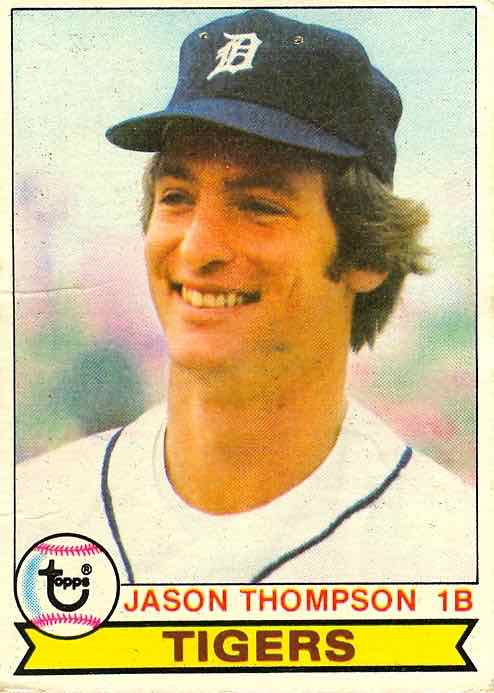
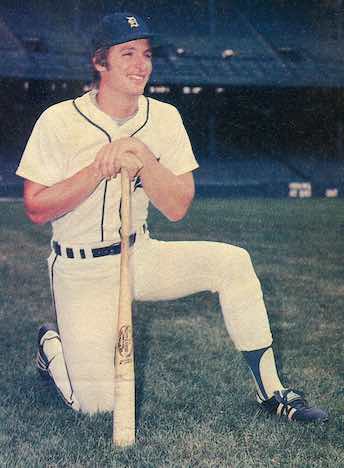
May 27, 1980: The Day the Tigers Traded Jason Thompson

Twenty-eight years ago today, Tigers GM Jim Campbell broke my heart.

On May 27, 1980, he traded my favorite Tigers player, first baseman Jason Thompson, to the California Angels for outfielder Al Cowens. (For more on Cowens, check out this post.)

The Hollywood native joined the Tigers full time in 1976 and played 123 games that year, hitting .218, with 17 home runs and 54 RBI. Two of the homers cleared the rightfield roof at Tiger Stadium. It was in 1977, though, that he made his mark: .270, 31 homers and 105 RBI — and earned an All Star Game selection.

The 1977 Tigers yearbook noted:

Jason led the Tigers with 31 home runs and 105 RBI — the first Tiger since Norm Cash (32) in 1971 to top 30 homers and the first since Willie Horton (100) in 1966 to attain the century mark in RBI.

At that point, the Tigers had to like their team of the future: Thompson, Lou Whitaker, Alan Trammell, Lance Parrish, Steve Kemp, Ron LeFlore, Jack Morris, et al, with a third baseman to be named later.

Thompson had another solid year in ’78, hitting .287 with 26 homers and 96 RBI.

The Beginning of the End in Detroit … Already?!

In 1979 he continued to hit homers and drive in runs — 20 and 79, respectively — but his average dropped 40 points to .246. That was also the year that Sparky Anderson arrived and, so the story goes, Thompson and Sparky didn’t mesh.

In 1980, Thompson got off to a slow start: .214/4/20 in 36 games, and Sparky invoked his My Way or the Highway clause and sent his first baseman to Orange County.

As I’ve said before, Thompson’s replacement, Richie Hebner, was a favorite of mine too. But, who were the Tigers kidding? Hebner over Jason Thompson?

From Anaheim to Pittsburgh to Montreal

Back home in southern California, Thompson thrived. In 102 games he batted .317 with 17 homers and 70 RBI. (Hebner hit .290/12/82.) On the eve of the 1981 season the Angels traded the three-time All Star to the Pirates for Ed Ott and Mickey Mahler.

In his five seasons in Pittsburgh, Thompson hit 93 home runs and averaged 93 RBI (not counting the 42 in the shortened ’81 season).

On April 4, 1986, the Pirates traded him to the Montreal Expos for players to be named later. Thompson played only 30 games for the Expos, hitting .196 with no home runs and just four RBI. On June 30, at the age of 31 and with balky knees, Jason Thompson was out of baseball for good.

The Jason Thompson Curse

If you remove the years that Darrell Evans and Cecil Fielder manned first base, the Tigers have had a revolving door at the position since they traded Jason Thompson. I call it The Curse of Jason Thompson: Hebner, Enos Cabell, Dave Engle, Keith Moreland, Tony Clark, Eric Munson, Carlos Pena, Chris Shelton, Sean Casey and Carlos Guillen. (And now, of course, Miguel Cabrera. Though I’m not convinced he’s long for first base.)

When looking back on the 1984 World Series team, I often think about how that team, or three-quarters of the starting nine, could’ve been homegrown talent — if Thompson were still in Detroit then.

With the exception of Chet Lemon and Larry Herndon, the Tigers could’ve had six of eight starters developed from Lakeland on up. (Or seven of nine if Morris or Dan Petry were on the hill.) Quite a different scenario from the 2008 Tigers when only two full-time, homegrown position players — Curtis Granderson and Matt Joyce — roam the field.

Today Thompson runs “Jason Thompson Baseball” in Auburn Hills, where kids can get hitting and fielding instruction from old #30 himself. He’s also an executive with Wachovia Securities.

If you can’t tell, even 28 years later I’ve still not gotten over the trade involving my favorite childhood player. I quickly hitched my wagon onto Hebner as a way to ease the pain. But that didn’t last long either, come to think of it.

So I threw my allegiance behind Kirk Gibson and five years later, when Gibson signed with the Dodgers, had to deal with the anguish all over again.
