This win was the Tigers’ 100th of the year, only the sixth time in franchise history to that point, and the first since 1968, they reached that mark. It was also The Cat’s final win and Willie’s final save of the regular season.
Speaking of Morris, he was outstanding: six innings, two hits, four walks and four strikeouts.
The Tigers offensive highlights were homers by Marty Castillo, his fourth of the year, and Kirk Gibson, his 27th.
Detroit’s next home game will be Game 3 of the American League Championship Series.
Miscellany
Venue: Tiger Stadium
Umpires: HP – Mike Reilly, 1B – Don Denkinger, 2B – Rich Garcia, 3B – Al Clark
Umpires: HP – Dave Phillips, 1B – Jerry Neudecker, 2B – John Hirschbeck, 3B – Steve Palermo
Time of Game: 3:51
Attendance: 43,972
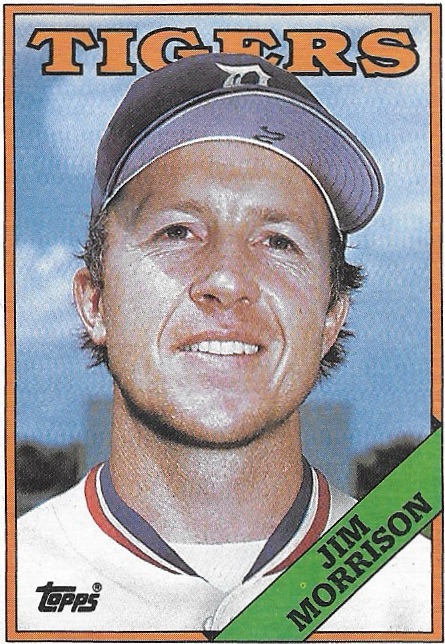
Jim Morrison – IF #9 and #17
The Tigers picked up Jim Morrison from the Pirates on Aug. 7, 1987 for a player to be named later* and Darnell Coles.
*Five days later, they sent Morris Madden to Pittsburgh to complete the trade.
Morrison was expected to be another veteran presence for a Tigers team that was, after a dreadful start, in the thick of the American League East race.
On Aug. 7 against the Yankees**, he made his Tigers debut (a game I attended) at third based and batting sixth. He led off the bottom of the sixth with a homer off New York starter Rick Rhoden.
**The Tigers won 8-0 and sat in third place, just a game behind second-place New York and a game and half behind Toronto.
When the Tigers got him, he was hitting .264 with the Pirates with nine home runs and a .726 OPS. Although Morrison became Sparky’s everyday third baseman for the rest of the year, that performance didn’t carry over to Detroit. He hit just .205 — which was still 20+ points higher than what Coles was hitting at the time of the trade.
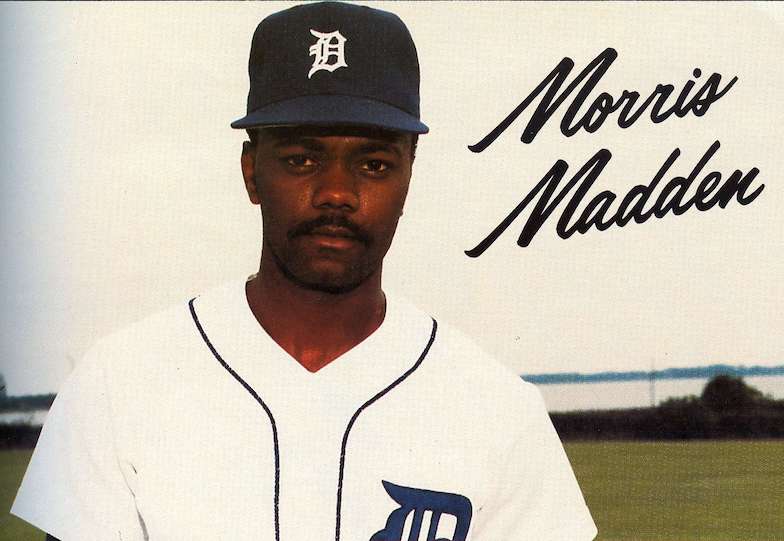
Lefty Morris Madden had a micro-career with the Tigers, appearing just twice during the 1987 season.
Appearance 1: On June 11 versus Milwaukee at Tiger Stadium, he came in during the sixth inning to relieve Eric King, who had relieved starter Jeff Robinson, with the bases loaded and walked Brewers second baseman Jim Gantner.
And that was the end of Morris Madden’s Tigers career.
Less than a month later, on Aug. 12, 1987, the Tigers sent Madden to the Pirates to complete the Aug. 7 trade of Darnell Coles for Jim Morrison.
If you’re wondering how he fared with Jim Leyland‘s Pirates, it depends on the year.
In 1988, he appeared in five games, allowed five hits and seven walks in five innings but didn’t allow a run.
In ’89, Madden pitched 14 innings across nine games — including three starts — he allowed a stunning 13 walks, 17 hits, 14 runs, 11 earned. Final ERA: 7.07.
On Nov. 21, 1989, he was released by the Pirates, and though he pitched for the AAA Albuquerque Dukes in 1990, his major-league career was over.
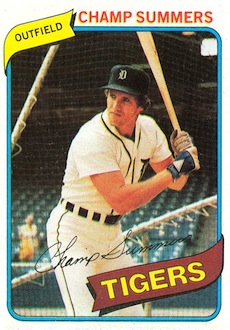
Champ Summers was a fan favorite in Detroit and for good reason. He came to the Tigers as a career underachiever — at least at the major-league level — in an under-the-radar trade roughly a week before they hired Sparky Anderson in 1979.
The Reds traded the 30-year-old Summers to the Tigers for a player to be named later on May 25, 1979. On Oct. 25, the Tigers sent Sheldon Burnside to the Reds to complete the trade.
The year before, John Junior Summers was the Minor League Player of the Year for the Reds’ top farm club, Indianapolis of the American Association. He led the AA with a .368 average, 34 homers and 124 RBI.
In 1979, Summers was hitting .200 with a single home run after 27 early-season games with the Reds, but after coming to Detroit, he had the best three seasons of his career.
That season he batted .313 with 20 home runs (14 solo) in 90 games and posted a .614 slugging percentage along with a 1.028 OPS. Anderson played Summers primarily in right field with a few DH assignments sprinkled in.
The Tigers rewarded him with a three-year contract near the end of the ’79 season.
Tigers fans loved Summers and he continued to provide punch to a young lineup. In 1980, his numbers slipped ever-so slightly but they were solid: .297/17/60 with an OPS of .897.
His production dropped further in the strike-shortened season of 1981 when, at age 35, his average fell to .255 and his power numbers plummeted, too. Summers hit only three home runs and eight doubles in 64 games in what would be his final season in Detroit.
In March 1982 the Tigers dealt him to the Giants for first baseman Enos Cabell. Summers would struggle in his two seasons in San Francisco, posting a .231 average and four home runs.
Acquired: Signed as a free agent on Nov. 23, 1985.
Seasons in Detroit: 1 (1987)
Uniform Number: 42
Stats: 0-0, 16.20 ERA, 1.2 IP
Don’t feel bad if you don’t remember Morris Madden‘s mini-career with the Tigers. He pitched just twice for Detroit during the 1987 season and one look at his stats tells you why.
On June 11 versus Milwaukee at Tiger Stadium, he came in during the sixth inning to relieve Eric King (who had relieved starter Jeff Robinson) with the bases loaded and promptly walked Brewers second baseman Jim Gantner. In his one inning of work, he allowed two earned runs and three walks. The Tigers lost the game 8-5.
Robinson’s next start, five days later at Toronto’s Exhibition Stadium, the lefty Madden came in to start the fifth inning. The first hitter he faced, Fred McGriff doubled to center, then Garth Iorg grounded out to Alan Trammell, advancing McGriff to third. Tony Fernandez singled, Lloyd Moseby flied out to center, then Jesse Barfield got an infield single. And that was the end of Morris Madden’s Tigers career.
Less than a month later, on Aug. 12, 1987, Madden was sent by the Tigers to the Pirates to complete the Aug. 7, 1987 trade of Darnell Coles for Jim Morrison.
If you’re wondering how he fared with Jim Leyland‘s Pirates, well it depends on the year. In 1988, he appeared in five games, allowed five hits and seven walks in five innings (!) but didn’t allow a run. In ’89, Madden pitched 14 innings across nine games — including three starts — he allowed a stunning 13 walks, 17 hits, 14 runs, 11 earned. Final ERA: 7.07.
On Nov. 21, 1989, he was released by the Pirates and while he pitched for the AAA Albuquerque Dukes in 1990, his major-league career was over.
Don’t feel bad if you don’t remember Morris Madden‘s mini-career with the Tigers. He pitched just twice for Detroit during the 1987 season and one look at his stats tells you why.
On June 11 versus Milwaukee at Tiger Stadium, he came in during the sixth inning to relieve Eric King (who had relieved starter Jeff Robinson) with the bases loaded and promptly walked Brewers second baseman Jim Gantner. In his one inning of work, he allowed two earned runs and three walks. The Tigers lost the game 8-5.
Robinson’s next start, five days later at Toronto’s Exhibition Stadium, the lefty Madden came in to start the fifth inning. The first hitter he faced, Fred McGriff doubled to center, then Garth Iorg grounded out to Alan Trammell, advancing McGriff to third. Tony Fernandez singled, Lloyd Moseby flied out to center, then Jesse Barfield got an infield single. And that was the end of Morris Madden’s Tigers career.
Less than a month later, on Aug. 12, 1987, Madden was sent by the Tigers to the Pirates to complete the Aug. 7, 1987 trade of Darnell Coles for Jim Morrison.
If you’re wondering how he fared with Jim Leyland‘s Pirates, well it depends on the year. In 1988, he appeared in five games, allowed five hits and seven walks in five innings (!) but didn’t allow a run. In ’89, Madden pitched 14 innings across nine games — including three starts — he allowed a stunning 13 walks, 17 hits, 14 runs, 11 earned. Final ERA: 7.07.
On Nov. 21, 1989, he was released by the Pirates and his career was over. But today we celebrate his 48th birthday. Three cheers for Morris Madden.




 dailyfungo.com